










How Offline AI Devices Are Enabling Powerful On-Device Intelligence Without Internet Access
How Offline AI Devices Are Enabling Powerful On-Device Intelligence Without Internet Access
The world is moving toward a future where powerful artificial intelligence operates independently of the internet. What once required massive cloud servers, ultra-fast connections, and energy-intensive data centers is now happening locally on compact chips inside everyday devices. This shift isn’t just technological—it’s philosophical. It challenges how we think about privacy, reliability, personal data, and the relationship between humans and intelligent machines.
Offline AI devices are rising fast across industries, enabling lightning‑fast responses, stronger security, and unprecedented autonomy. From smart home assistants that never need to send audio to the cloud, to medical wearables performing real‑time diagnostics, on-device AI is reshaping the fabric of innovation.
Offline AI isn’t just an alternative to cloud-based intelligence—it’s a revolution in autonomy, privacy, and performance.
What Makes Offline AI Devices So Revolutionary?

At the most basic level, offline AI refers to artificial intelligence models that run directly on a device without needing to connect to the internet or remote servers. This differs sharply from cloud-based AI, which relies on continuous data transmission to centralized systems that handle computation, storage, and model updates.
The distinction may sound small, but it has massive implications for performance and privacy. Cloud AI requires that data be uploaded, processed remotely, and then delivered back to the device—a cycle that introduces latency, privacy concerns, and dependency on network reliability. Offline AI eliminates that entire loop.
As AI models become smaller and specialized chips more powerful, offline intelligence is evolving from a niche capability into a mainstream expectation across consumer and industrial technology.
Key Advantages of On-Device Intelligence
Why are organizations across the globe rapidly adopting offline AI? Because the benefits are transformative across performance, privacy, reliability, and user trust.
Enhanced Privacy and Data Protection
With no need to send data to the cloud, offline AI provides one of the strongest possible safeguards for personal information. Sensitive data—from biometric readings to voice commands—never leaves the device.
This dramatically reduces exposure to cyberattacks, data breaches, or unauthorized third-party access. For industries like healthcare and finance, this level of local control is invaluable.
Ultra-Fast Processing and Zero Latency
Because computation happens at the source, responses occur instantly. There is no waiting for a server to respond, no lag when internet speeds fluctuate, and no bottlenecks caused by high network traffic.
Tasks like image recognition, anomaly detection, and voice processing feel seamless and immediate—providing smoother user experiences and enabling real-time applications.
Reliable Operation in Remote or Low-Connectivity Environments
Offline AI thrives in places where cloud AI fails—remote job sites, rural areas, underground facilities, or simply locations with unstable connectivity. This reliability is critical for mission‑critical operations such as field inspections, emergency response, or industrial automation.
Real-World Applications of Offline AI
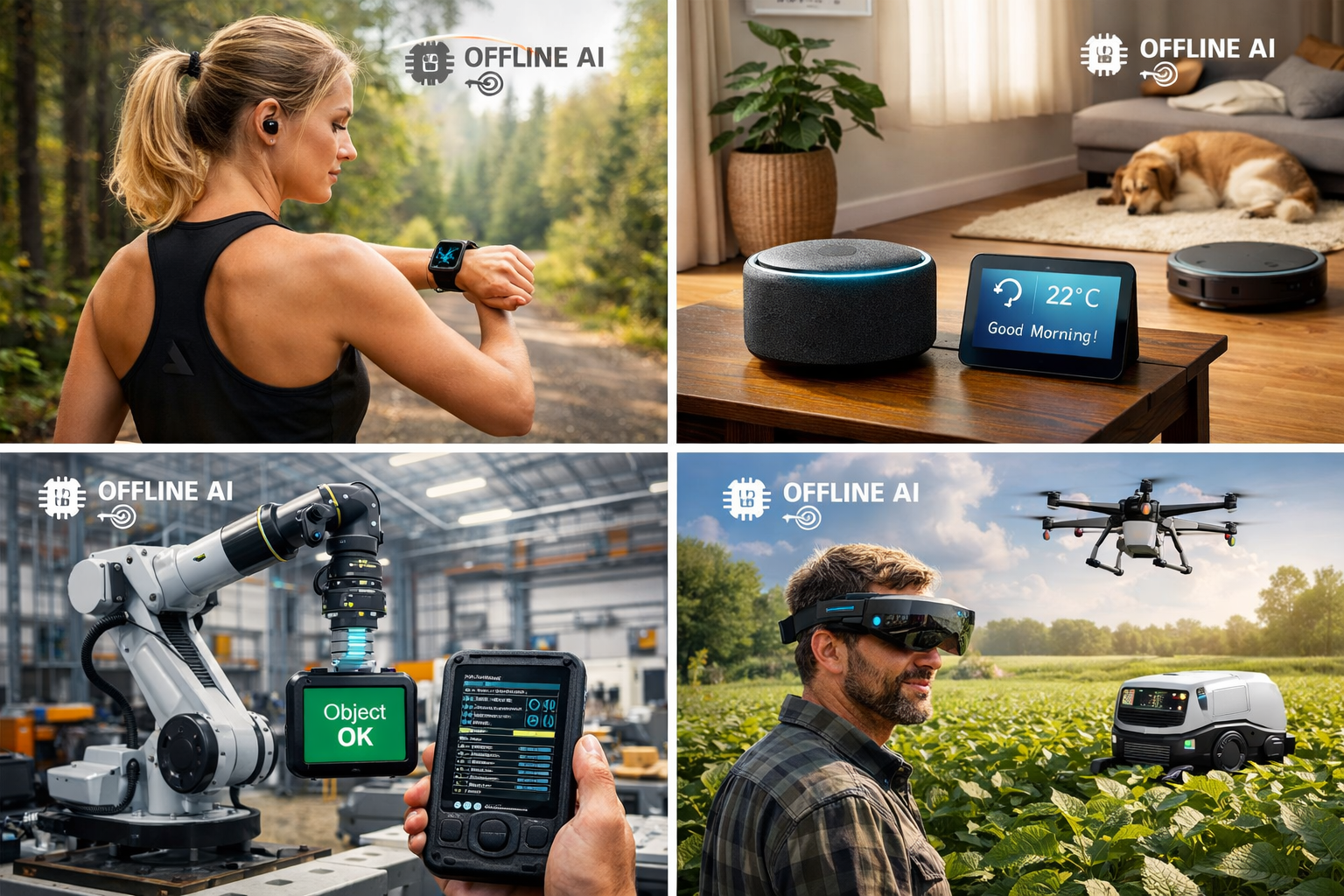
Offline AI is no longer an experimental concept—it is powering real, everyday technology across sectors. As specialized hardware becomes more affordable and AI compression techniques advance, offline intelligence is rapidly expanding into new domains.
Smart Home Devices That Respond Instantly and Privately
Modern home assistants, cameras, and sensors increasingly use offline AI to process data locally. This allows them to:
- Respond to voice commands without transmitting audio to the cloud
- Detect motion, recognize faces, or analyze environments instantly
- Operate securely even during internet outages
As consumers become more privacy‑conscious, this shift toward local processing is rapidly becoming a market‑defining feature.
Healthcare and Wearables Performing Real-Time Analysis
Wearables equipped with offline AI can track heart rhythms, muscle activity, blood oxygen levels, and more—all without sending sensitive health data to external servers.
This enables:
- Real-time detection of anomalies (e.g., arrhythmias)
- Early warning notifications without internet access
- Better patient privacy and safety
Industrial and Field Equipment in Remote Environments
Offline AI is increasingly used in mining, agriculture, construction, and energy sectors where connectivity is unreliable or nonexistent. Devices can:
- Analyze equipment health
- Identify inefficiencies
- Predict failures
- Enhance safety through hazard detection
This independence from cloud infrastructure boosts reliability and reduces operational costs.
How Offline AI Models Are Trained and Deployed
Although offline AI models run on-device, they are typically trained in large-scale cloud environments before deployment. The process involves several key steps that ensure the model can operate efficiently within the device’s hardware constraints.
Model Training on High-Power Servers
Large datasets and powerful GPUs are used to train the base AI models. Once trained, these models are too large and complex for most devices in their original form.
Compression and Quantization
To make models lightweight enough to run locally, developers use techniques like:
- Model pruning – removing unnecessary neurons
- Quantization – reducing precision (e.g., from 32-bit to 8-bit)
- Knowledge distillation – teaching a smaller model to mimic a larger one
These methods significantly reduce computational requirements while maintaining high accuracy.
Edge Optimization and Deployment
The final model is optimized for the specific device’s chipset—whether it’s a smartphone NPU, microcontroller, or dedicated AI accelerator. Once installed, the device can run AI tasks anytime, anywhere, with no external dependencies.
Challenges and the Future of Offline AI
Despite its rapid progress, offline AI faces some key challenges that continue to shape its development.
Hardware Limitations
Even with compression, AI models still require significant memory and processing power. Low-cost or compact devices may struggle to support advanced models without overheating or draining battery life.
Advances in AI Chips
The rise of NPUs, TPUs, and edge-optimized accelerators is helping overcome these challenges. These chips are specifically designed for local AI inference and offer massive performance gains over traditional CPUs.
The Next Wave of Offline AI Innovation
Looking forward, we can expect:
- More energy-efficient models designed specifically for edge hardware
- Smarter devices capable of federated learning without compromising privacy
- Hybrid systems that use cloud AI only when necessary
- AI that personalizes itself entirely on-device
The future of offline AI will be defined by autonomy, personalization, and trust—ushering in an era where intelligent devices truly serve the user.