






How Edge AI Is Transforming Everyday Devices in 2026

How Edge AI Is Transforming Everyday Devices in 2026
A deep dive into how on-device intelligence is reshaping the way we interact with technology in our homes, workplaces, and cities.
In 2026, edge AI has moved from an emerging concept to a mainstream technological foundation. It now powers everything from the smallest wearable sensors to industrial-scale machinery. The shift toward running powerful neural networks directly on devices—rather than relying entirely on cloud infrastructures—has unlocked a new era of responsiveness, personalization, and privacy.
As consumers grow more comfortable with AI-enhanced devices, the expectation for seamless, real-time performance has soared. Edge AI is not simply improving the tech we use; it is changing the very nature of how devices behave. Instead of static, pre-programmed systems, we now interact with technologies that learn continuously, adapt intelligently, and respond instantly to their environments.
Edge AI is transforming everyday devices into autonomous decision-makers capable of interpreting data, predicting outcomes, and taking action—all without depending on remote servers.
What Exactly Is Edge AI?
Edge AI refers to the deployment of artificial intelligence models directly on devices such as smartphones, appliances, sensors, vehicles, and industrial equipment. Instead of routing all data to cloud servers for processing, edge-powered devices analyze information locally.
How Edge AI Differs from Cloud AI
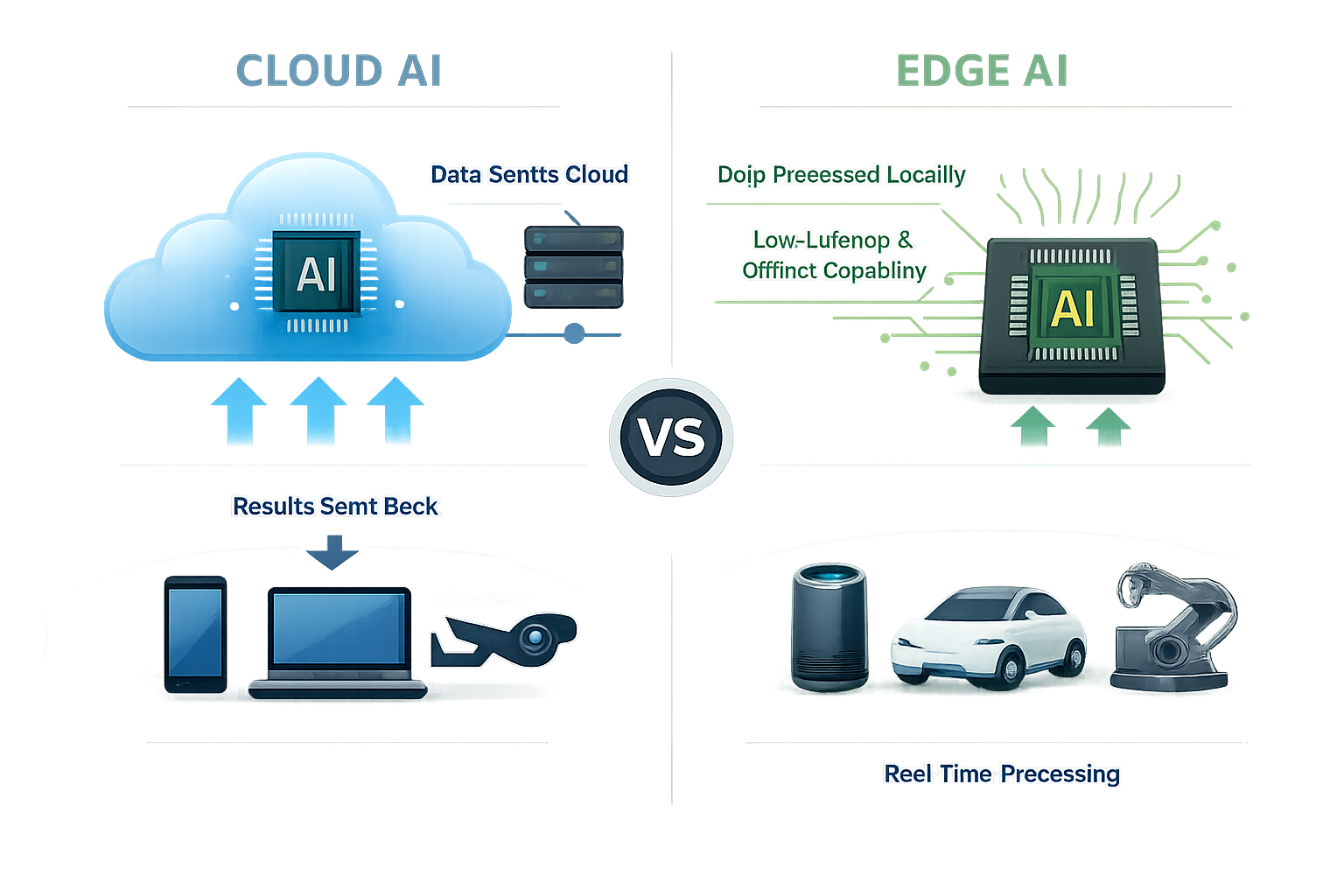
Cloud AI relies on remote servers to perform computational tasks. It is highly scalable, ideal for massive datasets, and central to training advanced AI models. However, cloud dependence creates limitations such as latency, connectivity requirements, and privacy concerns.
Edge AI, by contrast, performs inference—running AI model predictions—on-device. This reduces round-trip communication and allows models to operate even when offline. The result is near-instantaneous responses and significantly lower bandwidth usage.
- Cloud AI: centralized, network-dependent processing
- Edge AI: decentralized, device-level processing
Why On-Device Processing Matters in 2026
Three major factors have pushed edge AI into the spotlight:
- Speed: Processing data directly on-device eliminates network delays and yields real-time responsiveness.
- Privacy: Sensitive data never leaves the device, offering stronger protection.
- Reliability: Edge-powered devices function even in low-connectivity environments.
Smarter, Faster Everyday Devices
Today’s devices no longer simply follow programmed instructions—they interpret patterns, learn preferences, and optimize themselves over time. This shift has created a new category of smart technology that feels remarkably intuitive.
Appliances That Learn in Real Time
Modern appliances use on-device machine learning to track user behavior and optimize energy use, maintenance schedules, and performance. Smart refrigerators, for example, can recognize usage patterns and adjust cooling cycles. Washing machines detect fabric types and soil levels, modifying settings automatically for better results.
Wearables With Greater Accuracy
Wearable devices have benefited significantly from edge AI. By analyzing sensor data locally, they offer faster and more accurate health insights. From real-time heart irregularity detection to adaptive fitness coaching, wearables now act as proactive wellness companions.
Because data stays on the device, users gain improved security and more personalized, context-aware feedback.
Smartphones Running Advanced Models
Modern smartphones include specialized AI accelerators capable of running large models locally. Tasks like speech recognition, video enhancement, object detection, and translation occur on-device with near-zero latency.
The result: better performance, lower battery drain, and far more private user experiences.
How Edge AI Improves Privacy and Security

As digital interactions expand, users are more concerned than ever about how their data is used. Edge AI offers an elegant solution: keeping personal information local and limiting the need to transmit data externally.
Data Stays Where It Belongs
Because edge AI processes data directly on the device, it minimizes exposure to external threats. Sensitive information—like audio recordings, biometric data, and behavioral patterns—never leaves the user’s possession unless explicitly allowed.
This drastically reduces risk and aligns with growing expectations for ethical data handling.
Enhanced Security in a Connected World
Edge devices increasingly incorporate hardware-level security features, including encrypted AI accelerators and trusted execution environments. This creates multiple layers of defense and protects against tampering, interception, or unauthorized access.
By combining local processing with advanced hardware safeguards, edge AI empowers users with greater control and protection over their digital lives.
Real-Time Decision Making Across Industries
Edge AI is not limited to consumer devices. It is rapidly transforming industries where split-second decisions are crucial.
Healthcare: Instant Insights at the Patient’s Side
Edge-powered medical devices can analyze data the moment it is collected. Whether monitoring heart rhythms or detecting anomalies from imaging scans, on-device AI dramatically accelerates diagnosis and treatment.
This shift supports more personalized care, reduces strain on cloud systems, and enables advanced monitoring even in remote settings.
Automotive: Safer, Smarter Vehicles
Modern vehicles rely heavily on edge AI to process sensor data from cameras, radar, and LiDAR. Real-time interpretation is critical for collision avoidance, autonomous navigation, and driver-assistance systems.
The ability to process information locally improves reliability and safety—even when connectivity drops.
Retail: Enhanced Customer Experiences
Retailers use edge AI to monitor inventory, optimize checkout systems, and personalize customer interactions. From smart shelves to cashierless stores, the ability to make instant decisions helps businesses operate more efficiently and responsively.
Challenges and Future Opportunities
Despite its rapid progress, edge AI still faces obstacles. Running advanced models on small devices requires breakthroughs in chip design, power efficiency, and thermal management.
Hardware and Energy Constraints
Devices must balance processing power with battery life. Manufacturers are now exploring neuromorphic chips, low-power accelerators, and dynamic model scaling to bridge this gap.
Growing Ecosystems of AI-Optimized Chips
In 2026, nearly every major device manufacturer includes AI accelerators in their product lines. This ecosystem continues to evolve rapidly, enabling more powerful and specialized on-device processing.
Toward Personalized Autonomous Devices
The next wave of edge AI will bring hyper-personalized, fully autonomous devices that adapt to individual users over time. These systems will understand context, anticipate needs, and proactively offer assistance.
Explore the Future of Edge AI
Stay ahead of the curve with deeper insights into how emerging AI technologies are shaping daily life, industries, and the global economy. As edge AI continues to accelerate, understanding its impact will become essential for professionals, businesses, and tech enthusiasts alike.