


Hybrid Work in 2026: How Technology Is Quietly Redefining the Office

Hybrid work in 2026 feels very different from what it was just a few years ago. Back then, remote work was a crisis response, the office was still the default, and technology was something companies scrambled to make “good enough.” Today, hybrid work is intentional. It’s designed. It’s part of company identity rather than a temporary perk. And quietly in the background, technology has matured into the nervous system that keeps this new work reality connected and human.
The most important change? The conversation is no longer about where people work. It’s about how smoothly work can move — across locations, time zones, platforms, and people — without friction. That shift has influenced everything from office design to software to leadership culture.
AI Has Become the Silent Partner of Work
Artificial intelligence isn’t presented as a magic trick anymore. It has settled into a more meaningful role: the reliable colleague you don’t see, but who keeps everything moving.
Meetings are one of the clearest examples. Instead of draining marathons or administrative burdens, they’re now supported by AI companions that quietly handle details. They summarize discussions as they happen, capture key decisions, extract tasks, and generate follow-ups. Someone joins late? AI gives them a quick catch-up. Someone misses entirely? They receive a clean, readable recap instead of a 60-minute recording no one has time to watch.
The same shift has happened inside productivity tools. Emails respond faster because AI drafts thoughtful replies. Strategic plans build themselves from rough input. Complex datasets speak human language instead of formulas. Even managers benefit — not through surveillance, but through meaningful insight into workloads and team health.
The technology isn’t loud. It doesn’t dominate. It simply reduces effort so people can focus on actual thinking and collaboration.
The Office Didn’t Vanish — It Grew a Purpose
One of the most misunderstood hybrid work predictions was that offices would disappear. Instead, something smarter happened: they evolved.
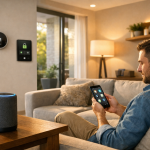
Walking into a modern workplace feels different. Desks aren’t monuments of ownership; they are flexible, smart resources. Sensors adapt lighting, temperature, and space allocation to real-time usage. Areas are designed not around cubicles, but around experience — collaboration studios, creative zones, strategy rooms, social hubs.
People don’t go to the office because it’s “Tuesday.” They go because being there offers value — the energy of brainstorming, the nuance of face-to-face conversation, the serendipity of quick chats that spark ideas. The office has become a collective space for moments that benefit from presence, not just a place to sit with a laptop.
In that sense, hybrid work hasn’t weakened workplace culture. It has made companies think harder about how to build it.
Digital Workplaces Finally Feel Natural
Not long ago, hybrid work was exhausting partly because technology got in the way. Too many platforms. Too many tabs. Too many disconnected conversations. Productivity died buried under productivity tools.
By 2026, this is far less common. Unified environments bring communication, files, project management, meetings, and AI together. Workflows feel connected instead of scattered. Teams don’t spend half the day jumping apps or hunting for information.
And beyond that, virtual collaboration is no longer limited to staring at faces in tiny boxes. Extended reality and immersive digital environments allow people to share spaces, sketch ideas together, or review 3D models even when they’re continents apart. Some companies maintain digital twins of their offices — virtual environments where remote employees can “enter” and genuinely feel present.
Technology isn’t replacing human connection. It’s finding new ways to support it.
Security Has Become Smarter and Less Annoying
A world where employees work from anywhere once terrified IT teams. Today, the approach has matured.
Security now focuses more on identity than location. It continuously and intelligently verifies that the person accessing information is who they claim to be — without constantly disrupting their work. AI flags unusual behavior, encryption remains constant, and policies adapt dynamically. Employees feel protected instead of restricted.
Hybrid work only works when trust exists. Modern cybersecurity makes that trust a realistic standard.
Well-Being and Data Are Finally Treated as Business Priorities
Perhaps one of the most human developments in hybrid work is the recognition that productivity and well-being are deeply linked. Companies no longer treat burnout like an individual weakness; they treat it as a system problem.
Work analytics help leaders understand team rhythms — not to police employees, but to prevent overload, reduce unnecessary meetings, and design healthier schedules. Focus time becomes protected. Meeting culture becomes more thoughtful. AI even nudges healthier habits when work intensity spikes.
Hybrid work has also opened doors globally. Teams now span countries by default, and technology helps bridge language, culture, and time-zone challenges. Talent is no longer limited to who lives near headquarters — and that diversity is reshaping innovation.
Where Hybrid Work Goes Next
Hybrid work in 2026 doesn’t feel experimental anymore. It feels stable, evolving, and increasingly human-centric. The road ahead points toward even smarter AI support, more personalized digital environments, greener intelligent offices, and a world where “remote” and “in-office” blur into one seamless experience.
But perhaps the most important truth remains simple:
Hybrid work isn’t really about technology.
It’s about people — and technology finally understands its role is to support them, not overwhelm them.
That quiet revolution is what’s truly shaping the future office.