



How Ultra-Wideband (UWB) Technology Is Transforming Indoor Navigation and Smart Device Interactions

How UWB Technology Enables Precise Indoor Navigation and Smart Device Interactions
Ultra‑wideband (UWB) has quickly become one of the most exciting wireless technologies of the decade. While it existed quietly for years in specialized industrial and military applications, UWB is now emerging as the backbone of next‑generation indoor navigation, hyper‑accurate location tracking, and intelligent proximity‑based device interactions. Its precision, speed, and spatial awareness capabilities unlock possibilities far beyond traditional radio technologies like Bluetooth or Wi‑Fi.
In environments where precise location matters—such as airports, smart homes, warehouses, retail stores, automotive systems, and AR experiences—UWB is ushering in an entirely new era of digital awareness. This article explores how the technology works, why it’s uniquely suited for indoor positioning, and how it’s enabling new interactions across the connected ecosystem.
What Is Ultra‑Wideband Technology?
Ultra‑wideband is a short‑range wireless communication protocol designed to deliver exceptionally accurate spatial and directional information. Unlike Bluetooth or Wi‑Fi—both of which transmit data over narrow frequency bands—UWB uses extremely short, low‑power pulses spread across a wide frequency spectrum. This allows it to capture incredibly precise measurements of distance and angle between devices.
One of UWB’s defining advantages is its ability to achieve centimeter‑level accuracy. Because the pulses are so short and sharp, devices can precisely measure how long it takes for a signal to travel between them, and then calculate distance using the speed of light. This method, known as time‑of‑flight (ToF), makes UWB ideal for environments where even small deviations in positioning can result in major performance differences.

Unlike GPS, which struggles indoors due to weak satellite signals, UWB thrives in indoor environments. Its resilience to interference and multipath effects (where signals bounce off walls or objects) gives it a substantial advantage in complex or congested spaces.
Key Takeaway
UWB’s wide frequency range and ultra‑fast pulses allow it to deliver location accuracy measured in centimeters, not meters—outperforming Bluetooth, Wi‑Fi, and NFC by a wide margin.
Why UWB Is Ideal for Indoor Navigation
Indoor navigation systems rely on the ability to pinpoint a device’s exact location, direction, and movement in real time. Traditional technologies have long struggled to meet these demands. Bluetooth beacons offer only meter‑level accuracy. Wi‑Fi triangulation is even more variable, often affected by network load and building layout. GPS, while excellent outdoors, becomes nearly useless inside.
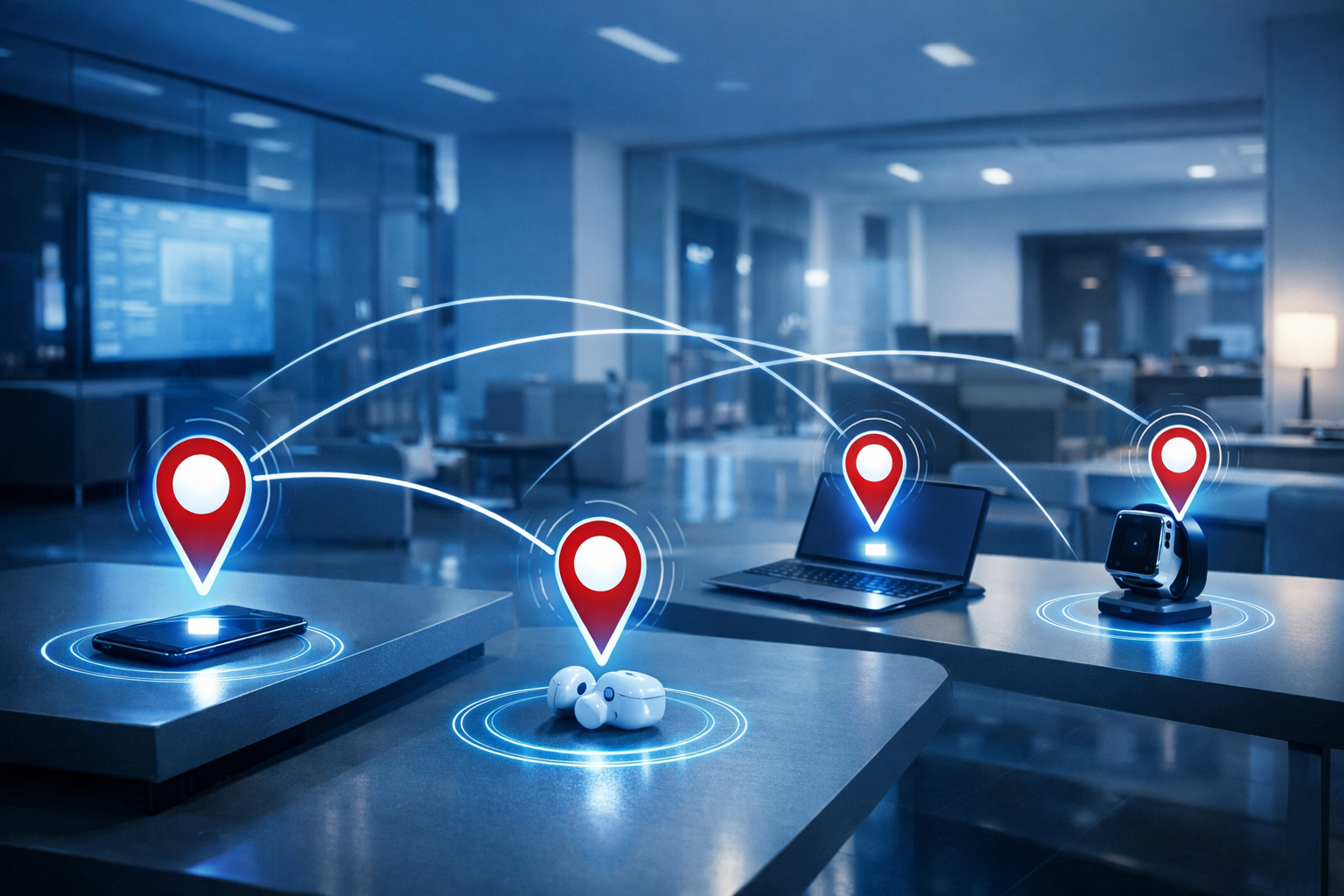
UWB overcomes these limitations using precise time‑of‑flight measurement. Essentially, a UWB anchor sends out an ultra‑short pulse; the receiving device immediately records the timestamp and calculates the distance based on how long the pulse took to arrive. With multiple anchors, the system can triangulate the device’s exact position in a three‑dimensional space.
In many tests, UWB systems routinely achieve accuracy of 10–30 centimeters, outperforming Bluetooth by a factor of ten or more. This level of precision creates opportunities for fluid, intuitive navigation in high‑traffic indoor environments.
Leading Use Cases for UWB Indoor Positioning
- Airports enabling passengers to find gates, lounges, and services with pinpoint turn‑by‑turn directions
- Warehouses using UWB to track forklifts, robots, pallets, and inventory with real‑time accuracy
- Retail stores leveraging UWB for aisle‑level product navigation and personalized shopping experiences
- Hospitals tracking equipment, staff, and patients to improve safety and reduce delays
UWB transforms indoor navigation by making it possible to locate people and objects not just within a room—but within specific zones, aisles, or even precise coordinates inside that room.
Smart Device Interactions Powered by UWB
Beyond indoor navigation, UWB is perhaps most visible in consumer electronics, where its spatial awareness capabilities create frictionless, intuitive interactions between devices. As more smartphones, smart locks, and vehicles integrate UWB chips, a new era of proximity‑based automation is emerging.

Proximity‑Based Access and Security
One of the most popular examples is hands‑free access. UWB-enabled vehicles and smart locks can detect not just whether your phone is nearby, but its exact location relative to the lock. This enables secure, automatic unlocking only when you are physically approaching from the correct direction. Unlike Bluetooth proximity, which can be spoofed or triggered through walls, UWB’s spatial precision makes it far harder to bypass.
Seamless Device Handoffs
UWB also enables devices to understand orientation—where they’re pointing, how close they are to each other, and how they’re moving. This makes handoff experiences far more fluid.
- Point your phone at a smart speaker to instantly transfer audio playback.
- Wave your phone near your laptop to switch file transfers into directional mode.
- Move your phone toward a TV to cast content with zero pairing steps.
These interactions feel natural precisely because UWB unlocks what other wireless standards cannot: real‑time spatial context.
UWB vs Other Wireless Technologies
To understand why UWB is so transformative, it helps to compare it directly with other popular wireless standards. While Bluetooth, NFC, and Wi‑Fi each excel in specific areas, none match UWB’s ability to deliver precise ranging and directional awareness.
Bluetooth
Bluetooth Low Energy (BLE) is widespread and inexpensive but offers only rough location accuracy—typically within 1 to 5 meters. It measures signal strength (RSSI), which fluctuates in response to walls, interference, and even human bodies.
Wi‑Fi
Wi‑Fi positioning uses triangulation from multiple access points, but interference and network congestion reduce reliability. Accuracy generally ranges from 3 to 15 meters—far too imprecise for detailed navigation.
NFC
NFC is extremely secure but operates only at very short ranges—usually a few centimeters. It’s great for payments but ineffective for spatial positioning.
Why UWB Stands Apart
UWB’s precision, low latency, and directional sensing make it uniquely suited for applications where reliability and accuracy are essential. Its ability to determine both distance and angle of arrival sets it apart from all other mainstream wireless technologies.
Key Takeaway
UWB doesn’t replace Bluetooth or Wi‑Fi—it complements them by providing spatial intelligence those standards were never designed to deliver.
Future Applications of UWB
As UWB chips become more affordable and adoption grows across smartphones, vehicles, smart homes, and IoT devices, new applications are emerging at a rapid pace.
Robotics and Automation
Robots equipped with UWB can navigate complex indoor environments with unprecedented accuracy. This dramatically improves safety, reduces collisions, and enables collaborative workflows between humans and machines.
Next‑Gen Smart Homes
Imagine lights that follow you from room to room, HVAC systems that adjust based on your exact location, or security systems that automatically detect unfamiliar movement. UWB makes these experiences not just possible but practical.
AR and VR Experiences
UWB can provide the precise positional tracking needed for seamless augmented or virtual reality experiences—especially in multi‑room or large‑scale indoor environments where GPS and Wi‑Fi fall short.
Enterprise Asset Tracking
From tracking medical equipment in hospitals to monitoring tools in construction sites, UWB’s accuracy ensures that critical items never go missing. This reduces costs, increases accountability, and improves operational efficiency.
As the ecosystem expands, experts predict that UWB could become as ubiquitous as Bluetooth within the next decade—powering everything from personalized retail to autonomous drones.
Stay Informed About Emerging Wireless Technologies
Ultra‑wideband is reshaping the future of indoor navigation, smart device interactions, and intelligent environments. As more industries adopt UWB‑enabled hardware, new innovations will continue to emerge across mobility, automation, entertainment, and consumer electronics.
Stay tuned for updates on the latest breakthroughs in UWB and next‑generation wireless connectivity.