










How Local-First Apps Are Transforming Privacy and Performance on Personal Devices

How Local-First Apps Are Changing Privacy and Performance
For more than a decade, the cloud has defined how we build and use software. Photos sync to the cloud, documents save to remote servers, and everything from messages to fitness logs often pass through third‑party providers before they reach our screens. But a major shift is underway — one that reverses the flow of data and returns control to where it began: the user’s own device.
This movement is known as local-first software, and it’s rapidly becoming a defining principle of modern app development. Local-first apps prioritize on-device computation, storage, and autonomy. Instead of depending on the cloud by default, they operate independently and use the cloud only as a secondary layer. This shift is transforming app privacy, performance, and user trust in ways that cloud-first software never could.
What Local-First Apps Actually Mean
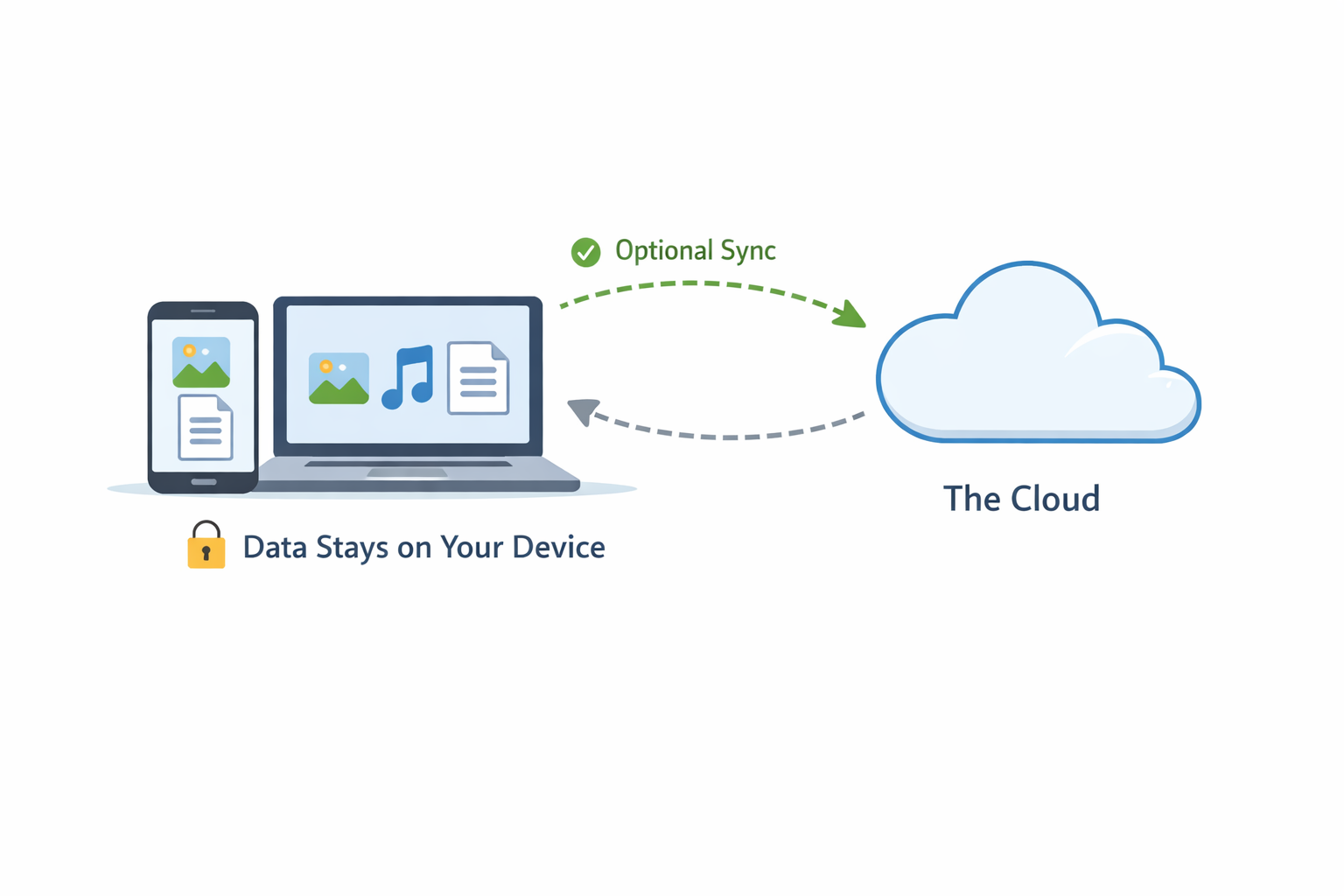
Local-first design begins with a simple philosophy: the data a user creates should belong to that user first. That means the user’s device—not the cloud—acts as the central source of truth. Only after storing and computing data locally does the app optionally sync to remote servers. And even then, the cloud becomes a backup or coordination tool rather than a dependency.
How Local-First Differs from Cloud-First
In cloud-first software, apps rely heavily on internet connectivity to function. Data is routinely uploaded, synced, and processed on remote servers. The device acts as a lightweight client, while the cloud does the heavy lifting.
Local-first software flips this architecture:
- Data lives on-device and syncs outward only when needed.
- Computation happens locally, leveraging powerful modern hardware.
- Apps remain fully usable—even feature-rich—while offline.
- The cloud becomes an enhancement layer, not an operating requirement.
A Privacy Revolution: User Data Stays With the User
Privacy is the most transformative advantage of local-first architecture. In an era marked by breaches, surveillance, and questionable data retention policies, users increasingly want control over what information leaves their devices. Local-first apps provide this by default.
If data never leaves the device, it never risks interception, improper access, or cloud vulnerabilities. That means sensitive content — including messages, personal notes, health logs, recordings, and photos — stays within the user’s physical control.
In a local-first world, cloud breaches become far less catastrophic because the cloud stores far less in the first place.
This shift aligns with the broader rise of digital sovereignty, a movement emphasizing user autonomy over digital identity, storage, and computation. Local-first apps give users a clearer sense of ownership and dramatically reduce the need to trust opaque cloud infrastructures.
Performance Gains Through On-Device Computing
Beyond privacy, local-first apps deliver a dramatic leap in performance. When computation and storage happen on-device, apps are no longer bottlenecked by network congestion, latency, or unreliable connectivity. Emerging hardware capabilities — including fast SSDs, neural engines, and multicore CPUs — make modern mobile devices more powerful than many old desktop computers.

Instant Load Times
Local-first apps can launch and load data almost instantly because they aren’t waiting for server responses. A note-taking app, for example, can display thousands of entries in milliseconds, even without a connection. A cloud-first counterpart may require multiple round trips to download updates or request content before the user can even begin.
Real-Time Interactions
Local computation reduces latency dramatically, enabling smooth typing, rendering, editing, and media playback. This is particularly important for:
- Design tools
- Video or audio editors
- Productivity apps
- Large document management tools
- AI-powered apps running inference on‑device
As mobile processors continue to improve, the distance between handheld devices and desktop-grade workflows continues to shrink.
Offline-First: A Feature, Not a Limitation
One of the most celebrated benefits of local-first design is the natural emergence of offline functionality. If your data and computation live locally, then going offline isn’t a failure state — it’s a normal mode of operation.
Cloud-first apps often treat offline scenarios as exceptions, relying on complex caching, placeholder screens, or reduced functionality. Local-first apps, by contrast, remain fully capable. Sync happens in the background when connectivity returns, not as a prerequisite for use.
This makes local-first software ideal for travelers, field workers, students in low-connectivity regions, or anyone operating in environments where reliable internet cannot be assumed.
The Technology Behind the Shift
The rise of local-first software is fueled by major advancements in several core technologies. Developers now have tools that enable seamless, conflict-free, privacy-forward local computing without sacrificing sync or collaboration.
CRDTs: Real-Time Collaboration Without the Cloud
Conflict-Free Replicated Data Types (CRDTs) allow multiple users to edit the same data simultaneously across devices without requiring a central server to resolve conflicts. Each device stores its own authoritative copy and merges changes deterministically. This enables:
- Offline editing with automatic merging
- Peer-to-peer sync
- Reduced server load
- True local ownership of data
Edge Computing and Modern Processors
Smartphones, tablets, and laptops now contain neural engines, GPUs, and specialized co-processors capable of handling workloads once reserved for servers. As a result, more tasks can run efficiently on-device, including:
- AI inference
- Encryption
- Media editing
- Data indexing
These improvements turn personal devices into powerful computational hubs, reducing dependence on centralized cloud infrastructure.
Privacy-Preserving Frameworks
Operating systems now provide secure APIs designed for local-first storage and cryptographic control. Encrypted local databases, secure enclaves, and system-level keychains ensure sensitive data remains protected without developer guesswork.
Combined with privacy-forward libraries and user-controlled syncing models, developers can now build apps that place user autonomy and data security above all else.
Conclusion: The Next Era of Software Is Local-First
The local-first movement represents a profound shift in how software is built and how users interact with their data. By emphasizing privacy, performance, autonomy, and offline resilience, local-first apps bring computing closer to the individual and further from centralized control.
As more industries adopt this model, the future of personal software will increasingly revolve around the device in your pocket — not the server farm across the globe.
Explore the Future of Local-First Software
Stay informed about emerging tools, frameworks, and trends reshaping how apps handle your data.
Whether you're a developer exploring next‑generation architectures or a privacy‑conscious user searching for better software alternatives, the world of local-first technology is full of opportunities. The shift is already happening — and now is the perfect time to be part of it.