









How Battery-Free Wireless Sensors Help Preserve Historic Buildings
How Battery-Free Wireless Sensors Help Preserve Historic Buildings
Discreet, low-maintenance monitoring can help conservation teams identify damaging conditions while limiting interventions in historic fabric. The key is matching the technology to the building—not the other way around.
A damp patch beneath a window may appear long after the first water entered. A room that feels comfortable during a midday inspection may become persistently humid overnight. Behind a cabinet, a cold external wall can create a microclimate quite different from the conditions measured in the center of the room.
For those responsible for historic buildings, these gaps in knowledge matter. Environmental monitoring helps reveal what happens between visits, giving teams evidence to investigate problems and prioritize maintenance. Battery-free wireless sensors can make that monitoring less demanding where changing batteries or installing cables would be difficult.
They are not a universal replacement for conventional instruments. Their value depends on reliable measurements, suitable energy sources, sympathetic installation, and a clear plan for acting on the results.
Why Historic Buildings Need Continuous Environmental Monitoring
Historic buildings contain materials that respond differently to moisture and temperature. Timber takes up and releases moisture; iron fittings can corrode in damp conditions; painted surfaces and decorative finishes may be vulnerable to repeated dimensional changes. Persistent moisture can encourage mold and, under suitable conditions, timber-decaying fungi.
Water can arrive through defective roofs, overflowing gutters, failed drainage, plumbing leaks, or moisture movement through the building fabric. Condensation is another possibility. Identifying which process is responsible requires more than observing that a space feels damp.
Occasional inspections remain essential, but they provide snapshots. A short-lived leak after wind-driven rain, a weekend heating change, or a humid pocket behind furnishings may go unnoticed. Regularly recorded measurements help connect these events to the conditions that precede deterioration.
However, there is no single ideal humidity setting for every historic building. A furnished historic house, an unheated church, and a gallery containing sensitive objects may require different approaches. The building’s established climate, the condition of its materials, and the needs of its collections all matter. Abruptly imposing a new environment can itself introduce risks.
A useful monitoring question might be, “Does the north-wall recess remain humid after rainfall?” That is more actionable than collecting readings everywhere without knowing what decision they will inform.
How Battery-Free Wireless Sensors Actually Work
“Battery-free” describes a power arrangement, not one standardized sensor technology. Two broad approaches are particularly important when considering building conservation.
Sensors that harvest ambient energy
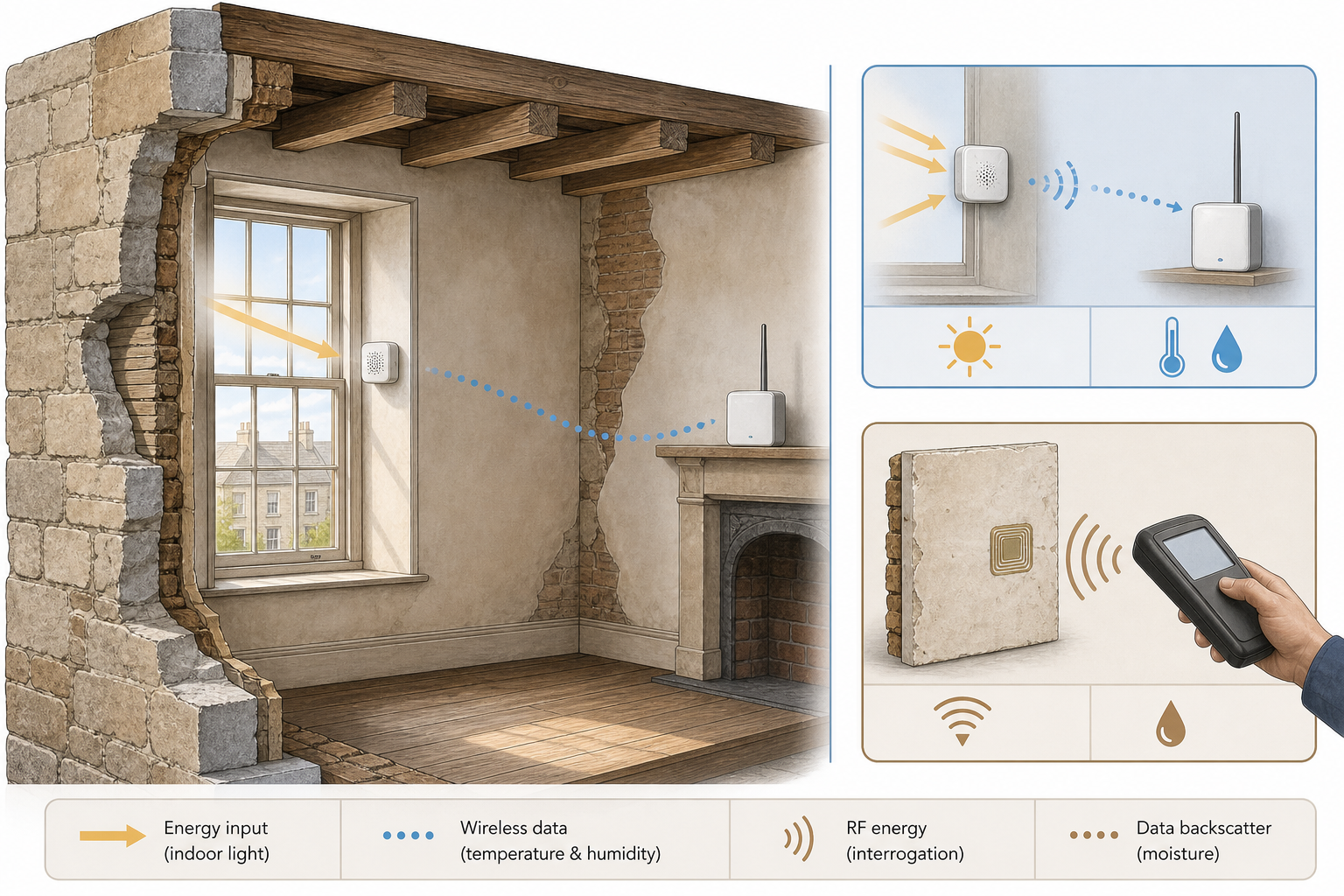
Energy-harvesting devices convert available energy into electricity. Depending on the design, that energy may come from indoor light, a temperature difference, vibration, or radio-frequency fields. The device may store a small amount in a capacitor or supercapacitor and use it to take measurements and transmit data.
Each source has practical limits. An indoor photovoltaic sensor may work near a bright window but struggle inside a shuttered room. A thermoelectric device needs a usable temperature difference, not simply a warm room. Vibration harvesting requires suitable movement, while radio-frequency harvesting depends on the available field and system design.
Our guide to how ambient energy powers battery-free devices explores the broader principle. In a heritage setting, the crucial question is how much energy is available at the actual installation point throughout the year.
Passive sensors energized by a reader
Other battery-free devices receive energy from a reader when interrogated. Depending on the technology, the reader might be handheld or installed nearby. The tag returns a measurement or a signal from which a measurement can be derived.
A passive tag does not necessarily create a continuous historical record on its own. If someone reads it only during a weekly visit, it may provide only a weekly observation. Fixed-reader arrangements can support more frequent measurements, but coverage and interrogation reliability must be demonstrated.
The infrastructure still needs power
In a typical networked system, sensor readings travel to a reader or gateway and then to a local or cloud-based monitoring platform. Gateways, networking equipment, and readers still require power. Some systems also depend on internet access, subscriptions, or periodic visits to retrieve data.
Battery-free does not mean continuously available or maintenance-free. Sampling frequency, transmission intervals, storage capacity, and radio range vary. Temperature and relative humidity are common targets, but measuring moisture within materials, cracks, or structural movement requires specifically designed and validated instruments—not an assumption that any wireless sensor can do everything.
What Conservation Teams Can Learn From Sensor Data
Locate vulnerable microclimates
Comparing temperature and relative humidity across selected locations can reveal persistent differences. A sheltered corner may stay humid after the main room has dried. A space behind a large furnishing may behave differently from an open circulation area.
Relative humidity also changes with temperature, even when the amount of water vapor has not increased. A rise in relative humidity is therefore not automatically evidence of a new leak. To investigate condensation, teams may need local surface-temperature measurements alongside air temperature and humidity. Condensation becomes possible when a surface reaches the local air’s dew point.
Track localized moisture changes
Suitably specified moisture sensors can help follow conditions near a repaired roof junction, a basement wall, or a previous leak. But their readings represent a particular location and measurement method—not the moisture condition of an entire wall.
Material type, salts, temperature, installation depth, and contact quality can influence some moisture measurements. Instrument selection and interpretation should therefore involve someone familiar with both the sensor and the building material.
Test explanations and evaluate repairs
Environmental data becomes more useful when compared with outdoor weather, visitor numbers, heating schedules, and maintenance records. Repeated increases after rain suggest a different investigation from changes that coincide with heating shutdowns or crowded events.
Before-and-after monitoring can also assess interventions. After gutter repairs, do local moisture readings decline over time? Following a ventilation adjustment, do humid episodes become shorter? Compare similar weather and operating conditions where possible, and allow for slow drying in thick masonry. An apparent improvement over a dry week alone does not establish that a repair succeeded.
Why Battery-Free Monitoring Can Suit Sensitive Heritage Sites
The clearest benefit is avoiding routine sensor battery replacement. Where equipment sits near fragile finishes or in difficult-to-access spaces, fewer visits can mean less handling, less disruption, and reduced need for ladders or access equipment.
Wireless communication can also avoid some cable routes through decorated interiors. However, gateways may still need electrical outlets and network connections. A supposedly cable-free installation can become intrusive if these requirements are considered too late.
A sensor is conservation-safe because of how it is selected, positioned, mounted, and managed—not simply because it has no battery.
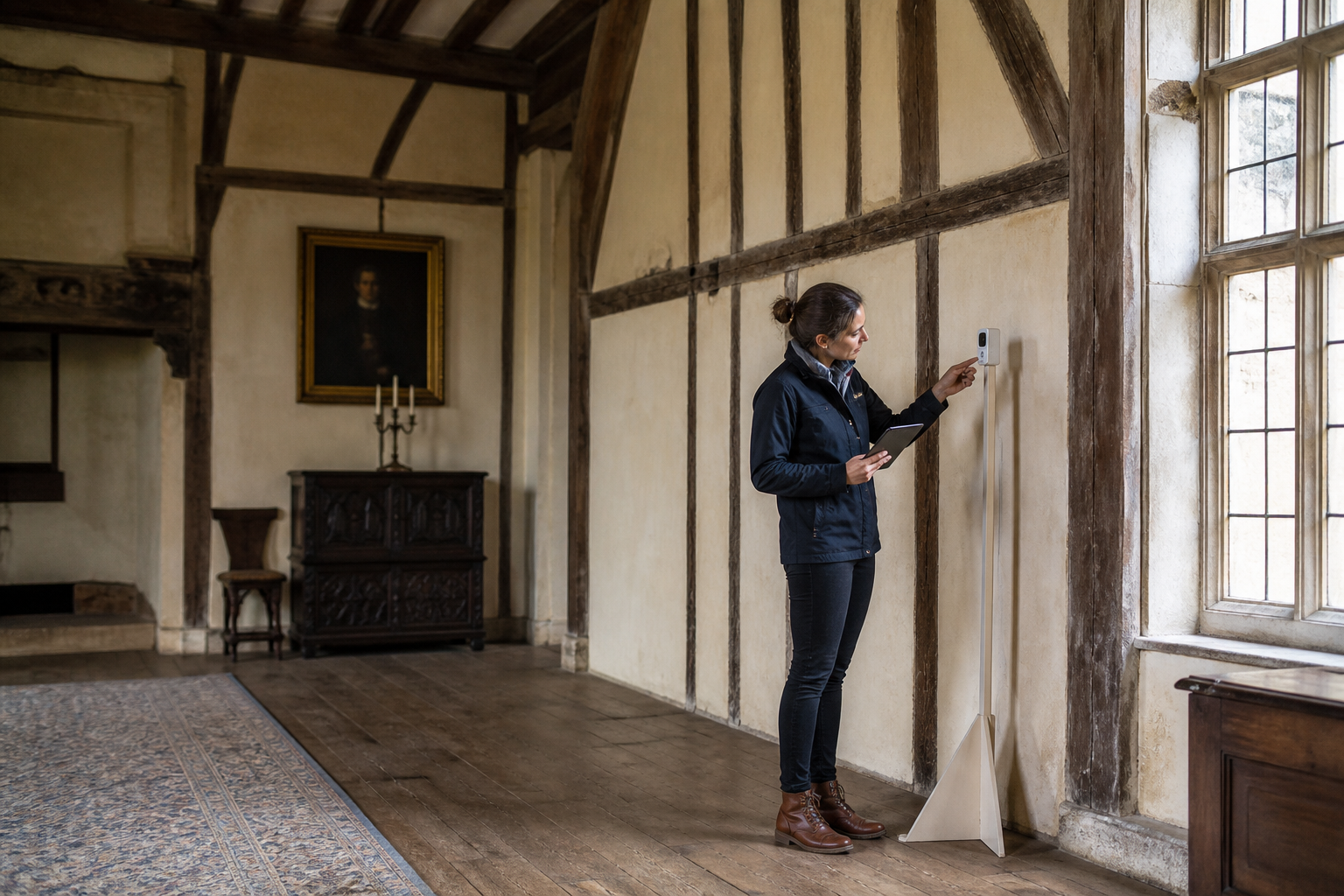
Discreet placement and conservator-approved reversible supports are central to non-invasive monitoring of historic buildings. Even removable adhesives can stain, lift paint, or leave residues on sensitive surfaces. Freestanding brackets may be preferable, provided they are stable, unobtrusive, and do not create trip hazards or interfere with cleaning.
These advantages can be particularly useful in intermittently staffed churches, small museums, and historic houses with limited maintenance capacity. Nevertheless, someone must still review the data and check equipment condition.
There may also be environmental benefits from reducing disposable batteries and maintenance journeys. As with other technologies intended to support sustainability, the full lifecycle matters: device manufacture, gateway electricity use, travel, service life, and eventual disposal all contribute. Removing batteries alone does not prove a lower overall footprint.
How to Plan a Conservation-Safe Sensor Installation
Begin with a condition survey and a specific question. Then work outward to sensor selection, placement, communications, and data management. This sequence avoids buying a system first and trying to find a useful role for it afterward.
- Define the conservation decision. Identify the vulnerable material or location and explain what evidence would trigger inspection, maintenance, or further investigation.
- Select representative locations. Include the suspected problem area and, where useful, a comparison location. Avoid direct sunlight, heaters, or drafts unless those effects are what you intend to study.
- Test energy and radio conditions together. Thick masonry, metalwork, enclosed voids, and closed doors can affect communication. A position with good light may not represent the microclimate you need to measure.
- Run a small pilot. Compare readings with an appropriate reference instrument. Check reporting intervals, timestamps, missing data, and recovery after energy or network interruptions.
- Approve mounting and permissions. Agree on installation with conservation specialists and the site’s responsible authority. Obtain any required consent before placing equipment on or near protected fabric.
- Document ownership and removal. Record who maintains the installation, who owns the data, and how every component will be removed without damage.
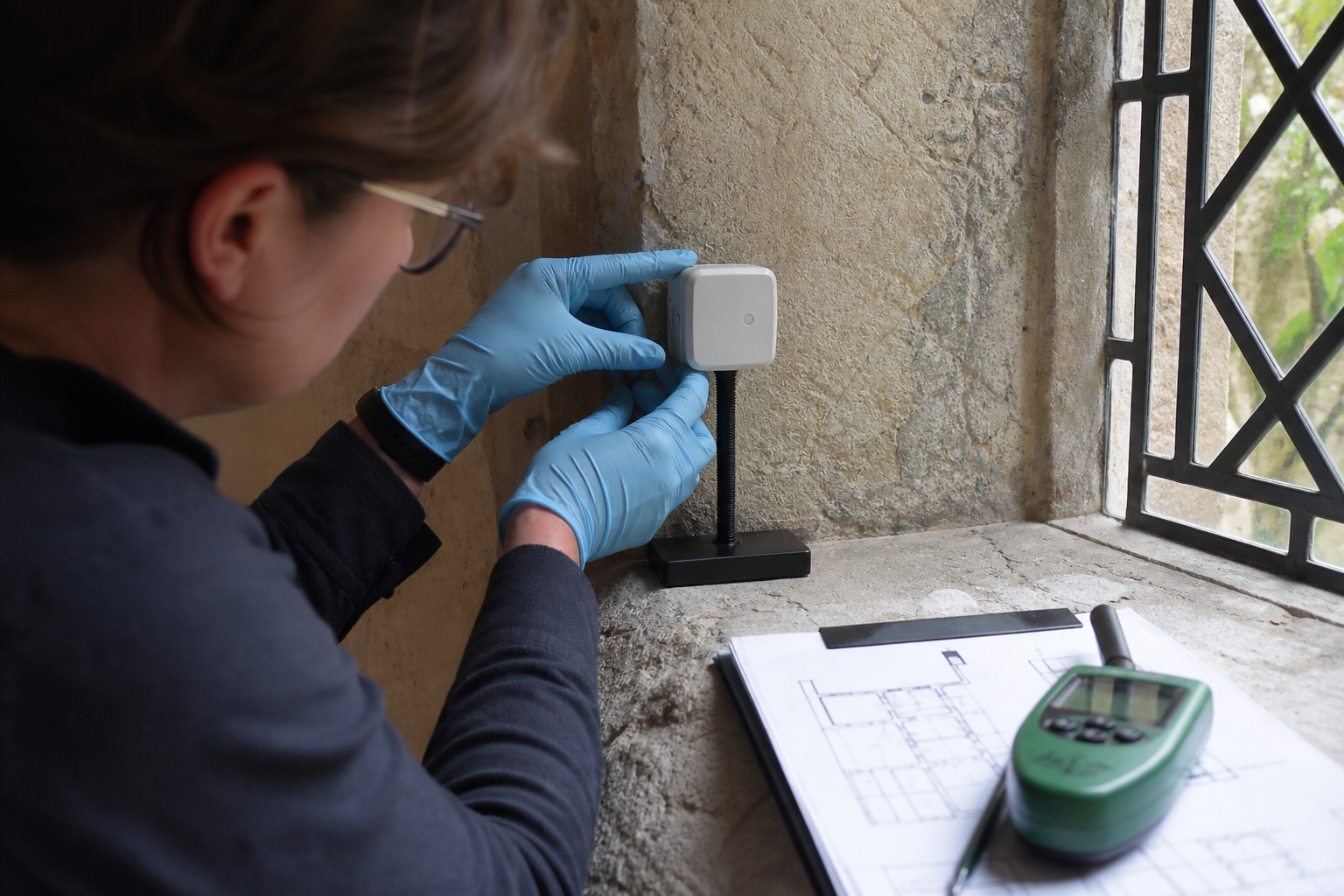
Test against the least favorable conditions, not just those on installation day. For a light-powered device, winter daylight, closed shutters, dust, or temporary display changes can be decisive. If a full seasonal trial is not possible, treat early performance claims as provisional and establish a plan to revisit them.
Create a sensor register containing the device identifier, location photograph, mounting method, measurement specification, calibration or verification requirements, reporting interval, and responsible person. Record any relocation: moving a sensor can create a discontinuity that looks like an environmental change.
Agree in advance on acceptable measurement uncertainty, data completeness, reporting delays, and outage behavior. A working dashboard is not enough if missing readings coincide with the periods you most need to understand.
Turn Measurements Into Decisions—and Understand the Limits
Establish a baseline that captures relevant operating patterns and seasonal variation. A full annual cycle can be valuable, although active leaks or obvious deterioration require prompt investigation rather than waiting for a complete dataset.
Set alert thresholds with a conservation professional. Consider the magnitude, duration, rate of change, and sensitivity of the affected materials rather than relying on a universal humidity target. Carefully chosen delays or persistence rules can reduce nuisance alerts without hiding important events.
Give every alert an owner
A practical response plan should specify who reviews trends, who investigates alerts, and who covers absences. Treat missing readings as a separate issue: silence may indicate insufficient harvested energy, a communication failure, or a platform problem—not stable conditions.
Keep an event log of storms, repairs, changes to heating, unusual occupancy, and instrument checks. These notes help distinguish building behavior from operational changes and measurement faults.
Compare the whole system, not just the sensor price
Evaluate total ownership costs against battery-powered and wired alternatives. Include readers, gateways, electrical work, installation access, subscriptions, calibration, staff review time, connectivity, and replacement hardware. A conventional logger can be the better choice if it offers more reliable evidence with less complexity.
Ask suppliers about data export, ownership, access controls, local storage, outage recovery, security updates, and support duration. Confirm whether the installation can keep recording when the internet connection fails and whether historical data remains accessible if a subscription ends.
Repairability and end-of-life arrangements matter too. The principles behind making electronics easier to repair, resell, and recycle are relevant when choosing monitoring hardware intended for long service.
Finally, sensors support—not replace—inspections, material assessment, and expert diagnosis. They can show that a condition changed without proving why. If energy availability, measurement accuracy, or connectivity cannot meet the monitoring need, a wired or battery-powered approach may be more appropriate.
Start With One Conservation Question and a Small Pilot
Battery-free wireless sensors can support preventive conservation by revealing environmental patterns while reducing battery changes and some cable installations. Their strongest contribution is reliable, location-specific evidence that helps teams investigate moisture problems and judge whether interventions work.
Success depends on suitable energy conditions, validated measurements, reversible installation, and a clear response process. Neither battery-free power nor wireless communication automatically makes a system non-invasive or dependable.
Choose one vulnerable room or recurring moisture concern, involve your conservation team, and test a small installation. Expand only when it produces evidence you can trust—and decisions that help protect the building.