









How Satellite-to-Phone Messaging Expands Connectivity Beyond Cellular Coverage

How Satellite-to-Phone Messaging Expands Everyday Connectivity Beyond Cellular Coverage
Direct-to-device satellite messaging is changing what “no service” means. When a compatible phone cannot reach a traditional cellular network, it may still be able to exchange a short message through a satellite overhead. That capability is especially valuable in remote places and emergencies, but its everyday value is broader: it gives travelers, field workers, families, and commuters another way to stay reachable when the nearest cell tower is far away.
Why Cellular Coverage Still Has Everyday Gaps
Modern cellular networks are remarkably capable, but they are built around terrestrial infrastructure: towers, backhaul connections, power, permits, and demand concentrated near where people live and work. In cities and suburbs, that infrastructure can provide fast, reliable service. Outside those areas, the economics and terrain become much more difficult.
A mountain ridge can block a signal that was available only minutes earlier. A winding rural highway may pass through long stretches with no meaningful coverage. Dense forest, deep valleys, deserts, offshore waters, and sparsely populated communities all create conditions where a phone may show little or no cellular service. Severe weather, wildfires, floods, and power failures can also interrupt local infrastructure precisely when communications matter most.
These gaps are not limited to dramatic expeditions. They appear during ordinary moments:
- Road trips and daily driving: A breakdown, flat tire, or closed road can become more stressful when there is no signal to update someone or ask for assistance.
- Outdoor recreation: A day hike can extend beyond the planned route, and a campground may be only a few miles from service but effectively disconnected.
- Remote work sites: Construction crews, ranchers, survey teams, and utility workers often operate well beyond consistently covered areas.
- Visits to rural family or destinations: Many people encounter unreliable coverage without thinking of themselves as “off-grid.”
Satellite-to-phone messaging is designed for this exact handoff point: the moment a compatible phone cannot connect to a terrestrial network. Rather than treating that moment as the end of communication, the phone can use an available satellite service to send a smaller, more deliberate type of message.
Key takeaway
Satellite messaging does not make every place feel like a city network. It provides a practical fallback for essential communication when ordinary mobile coverage is unavailable or unreliable.

How Satellite-to-Phone Messaging Works
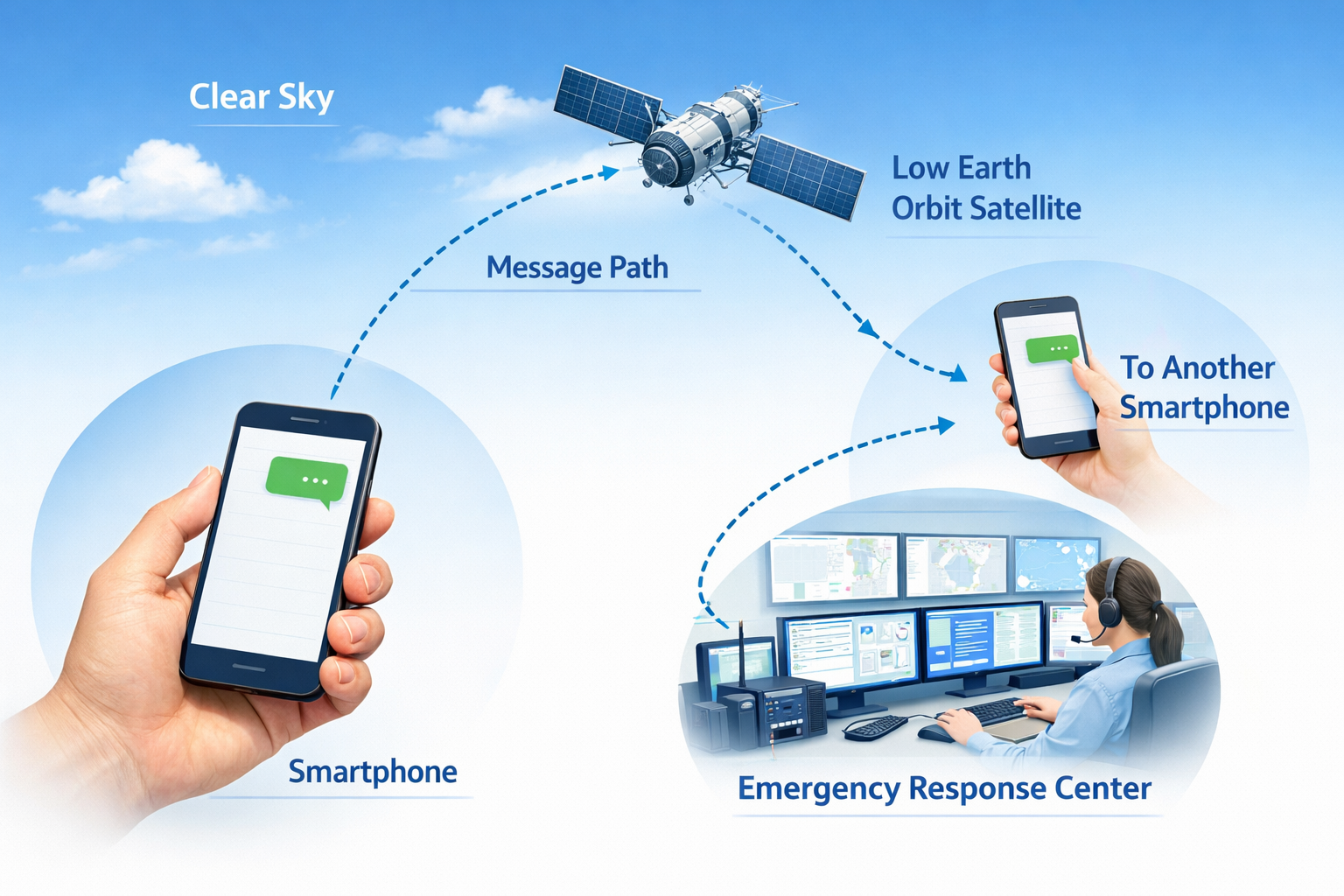
The basic idea is simple: instead of communicating with a nearby cell tower, a compatible phone communicates with a satellite passing overhead. The satellite then relays the message through its network and ground infrastructure so it can reach a recipient, a designated contact, or an emergency response coordination service.
In many current implementations, the satellites operate in low Earth orbit. They move relative to a person on the ground, which means availability can depend on timing, location, the satellite network, and whether the phone has a sufficiently open view of the sky. A device may guide a user to orient the phone or move toward a clearer location before sending.
Why messages are brief by design
A satellite connection is not the same as a home broadband line or a strong 5G signal. The radio link must cover an enormous distance, share limited capacity, and work under changing conditions. That is why satellite-to-phone features commonly prioritize small, high-value data exchanges: text messages, location coordinates, status check-ins, and emergency details.
That limitation is also a design strength. In an urgent situation, a concise message such as “Delayed but safe; parked at mile marker 48; sharing location” is often more useful than an unreliable attempt to load a map, stream video, or start a voice call. The goal is not to replicate every online activity. It is to preserve a dependable path for the information that matters first.
What the sending experience can feel like
Satellite messaging can require more patience than a regular text. Delivery may take longer, particularly with partial sky obstruction, difficult weather, a moving user, or heavy network demand. Buildings, canyon walls, tree cover, and vehicle roofs can all reduce the quality of the connection. A message that would be instantaneous over cellular service may take several minutes through a satellite path.
Think of satellite messaging as a resilient communications lane, not an invisible extension of unlimited mobile data. It is most effective when users send clear, concise information and give the connection time to complete.
Features also differ by phone model, operating system, carrier partnership, service plan, region, and local regulation. Some services focus on emergency messaging, while others may offer person-to-person texts, check-ins, or location sharing. Before relying on any feature, review what your specific device and plan support where you expect to travel.
Everyday Situations Where Satellite Messaging Makes a Difference
The strongest case for direct-to-device satellite connectivity is not that everyone will use it every day. It is that people can use it on the day a familiar connection disappears. For many users, that added layer of reachability changes planning, response time, and peace of mind.
Outdoor recreation and backcountry travel
Hikers, campers, climbers, boaters, and backcountry skiers have long relied on specialized satellite communicators when venturing beyond coverage. Satellite capability built into a phone can lower the barrier to carrying a communications backup. A user can share a location with family, send a check-in after reaching camp, update a plan when weather changes, or request help when a situation becomes serious.
It is still important to prepare responsibly. A satellite message is not a substitute for route planning, weather awareness, supplies, navigation skills, or telling someone where you are going. It is one more safeguard in a broader safety plan.
Travel, transportation, and unexpected delays
Long-distance drivers often move in and out of coverage without noticing—until an accident, detour, mechanical problem, or weather event occurs. Satellite messaging can help a driver notify a contact, communicate a location, or explain a delay from a road where ordinary service is absent.
The same principle applies to remote destinations. A traveler may not need a continuous data connection, but the ability to send a short update can be valuable when transportation schedules change or a group becomes separated. The practical benefit is simple: a lack of bars no longer has to mean a lack of options.
Field operations and community resilience
For field teams, connectivity is often operational rather than merely convenient. Utility crews, inspectors, environmental researchers, agricultural workers, logistics teams, and emergency volunteers may need to report status from places with weak infrastructure. During storms or wildfires, even areas that usually have cellular service may lose it temporarily.
Satellite messaging can provide a lightweight backup channel for a supervisor check-in, a location update, or a request for additional resources. It should be incorporated into an organization’s communication procedures, including clear escalation rules, contact lists, check-in intervals, and battery management.
Family peace of mind
Not every satellite message has to signal danger. A short “I made it to the trailhead,” “Running late but safe,” or “Camping tonight; location shared” can reduce uncertainty for the people waiting at home. This is one of the most human uses of the technology: it preserves small moments of reassurance in places where connectivity has traditionally been unpredictable.
The value is often reassurance, not novelty
For most people, satellite messaging will be used rarely. But when a delayed traveler, remote worker, or outdoor adventurer needs to send one important update, a single successful message can be enormously meaningful.
What Satellite Messaging Can—and Cannot—Replace
As direct-to-device services expand, it is easy to assume that satellite connectivity will replace conventional mobile service. That is not the current reality. Cellular networks remain far better suited to the high-capacity, low-latency activities that shape everyday phone use: browsing, app updates, video conferencing, streaming, navigation with live data, large photo uploads, and file transfers.
Satellite messaging is best understood as a complement to cellular coverage. It can extend the reach of essential communications, but it works within physical and service constraints. Open sky matters. Power matters. Feature availability varies. And message timing may be less predictable than people expect from standard texting.
Know the limits before you need the feature
Before a trip or remote work assignment, verify the details that apply to your situation. Do not assume that a phone with satellite hardware provides every feature in every place.
A practical pre-departure checklist
- Confirm device compatibility. Check whether your exact phone model supports satellite messaging and whether a software update is required.
- Review carrier and plan terms. Determine which message types are included, whether activation is required, and whether usage limits apply.
- Check regional availability. Satellite services may be unavailable in certain countries, jurisdictions, or remote territories.
- Practice before travel. Learn how your phone indicates satellite availability, how to compose a message, and how location sharing works.
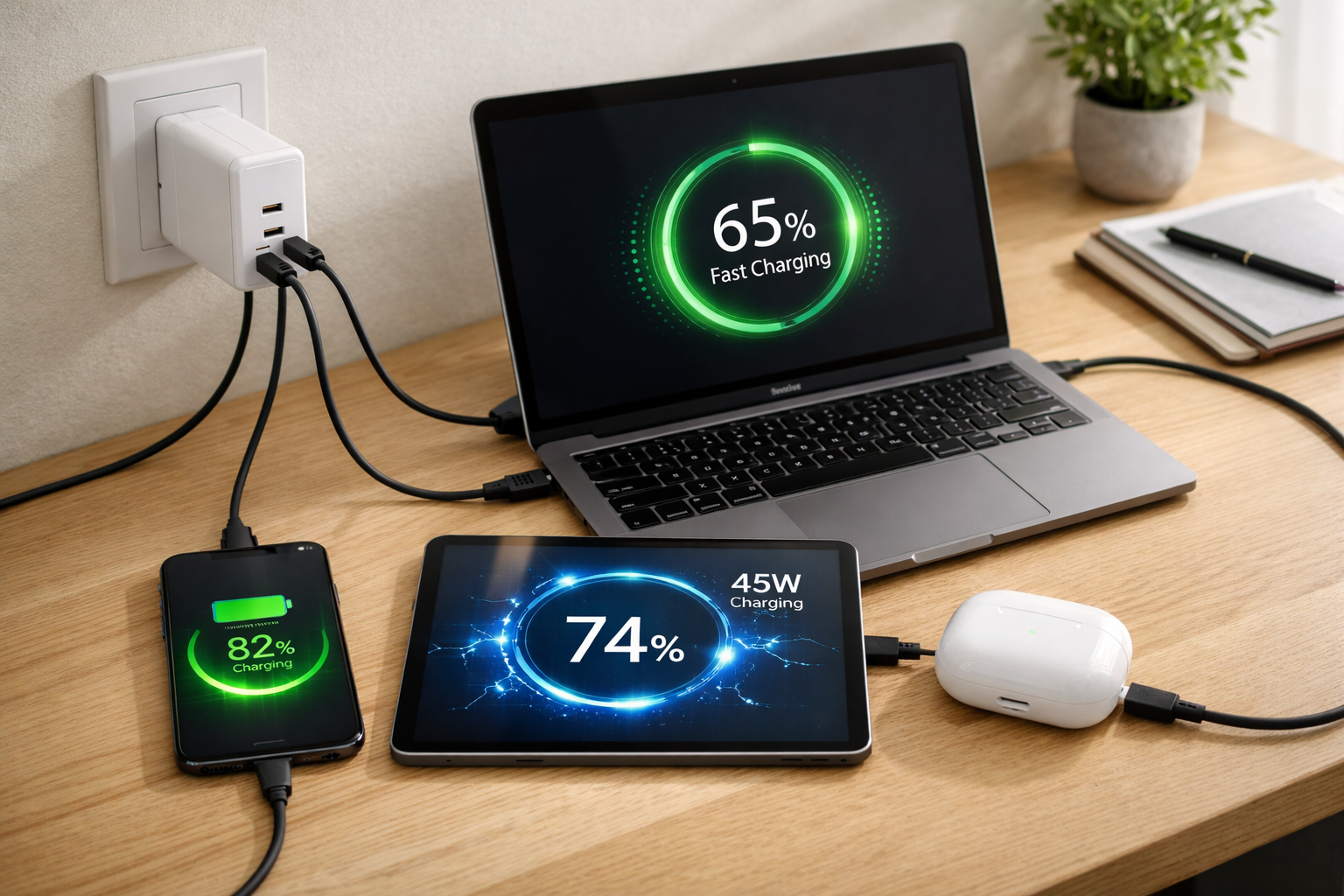
- Charge deliberately. Carry a power bank, reduce unnecessary battery drain, and avoid arriving in a remote area with a nearly empty phone.
- Plan for open sky. If it is safe to do so, move away from dense canopy, steep terrain, buildings, and other obstructions before trying to connect.
- Keep messages specific. State who you are, where you are, what happened, what you need, and whether anyone is injured or in immediate danger.
Emergency satellite features should also be used thoughtfully. If there is an immediate threat to life or safety, contact emergency services through the fastest available method. Where satellite emergency messaging is supported, provide accurate details and follow on-screen instructions. Do not treat the feature as a reason to take avoidable risks or delay calling for help when cellular service is available.
The Future of Direct-to-Device Satellite Connectivity
Direct-to-device satellite connectivity is developing quickly through the combined work of satellite operators, handset makers, mobile carriers, and emergency-response partners. Improvements in satellite constellations, antenna technology, network integration, and device software are expected to expand the usefulness of low-bandwidth services over time.
The near-term direction is likely to remain practical: more dependable messaging, broader service footprints, easier location sharing, and better integration with the messaging tools people already understand. New capabilities may appear gradually, and their availability will continue to depend on spectrum, regulation, carrier agreements, and local network conditions.
The larger change is cultural as much as technical. For decades, people have accepted that certain roads, trails, worksites, and communities were simply disconnected. Satellite-to-phone messaging begins to narrow that divide. It cannot erase every coverage limitation, but it can make connectivity more continuous across the boundary between built-up areas and remote terrain.
The emerging expectation is straightforward: a phone should remain useful when the nearest cell tower is out of reach—not for everything, but for the message that cannot wait.
That expectation will encourage better planning as well as better technology. Travelers may be more willing to share an itinerary when they know they have an off-grid check-in option. Organizations may refine continuity plans around lightweight messaging. Families may gain an additional tool for staying connected without demanding constant online access from the people they care about.
Connectivity That Reaches Further
Satellite-to-phone messaging is most valuable when it is treated as a resilient backup, not a replacement for strong cellular service or sensible preparation. It gives compatible devices a way to send essential information from rural roads, mountain trails, remote worksites, offshore areas, and communities affected by disrupted infrastructure.
Its limits are real: messages may be slow, the sky must often be clear, support varies by device and region, and data-heavy tasks remain outside its core purpose. Yet those limits do not diminish the importance of a reliable check-in, a shared location, or an emergency request when traditional service is unavailable.
Prepare for the Moments When Cellular Service Ends
Check whether your phone and mobile plan support satellite messaging, learn the feature before you need it, and add it to your off-grid travel or work safety plan. A few minutes of preparation can make the next no-service moment far less isolating.