




How Vehicle-to-Home Charging Turns Electric Cars Into Backup Power
How Vehicle-to-Home Charging Makes Electric Cars Flexible Sources of Backup Power
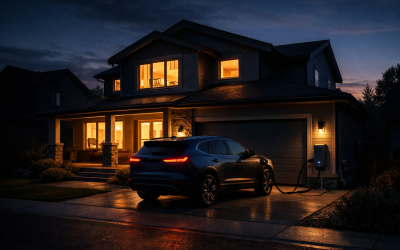
An electric vehicle is often the largest battery a household owns. Vehicle-to-home charging, commonly called V2H, gives that battery a second job: supplying electricity to selected home circuits when the grid is unavailable. With the right vehicle, hardware, and electrical installation, an EV can help preserve food, communications, lighting, and other essentials through an outage.
V2H is not as simple as running an extension cord from a car to a refrigerator. It is a managed backup-power system designed to protect utility workers, household equipment, and the vehicle itself. Understanding how the system works—and where its practical limits lie—can help homeowners decide whether EV backup power belongs in their resilience plan.
What Is Vehicle-to-Home Charging?
Vehicle-to-home charging is a form of bidirectional energy transfer. In conventional charging, alternating-current electricity from the grid flows through charging equipment and into the EV battery. A V2H-capable system can reverse that direction, allowing stored energy in a compatible vehicle to flow back through approved equipment and into a home’s electrical system.
That distinction matters because the home’s wiring expects electricity with carefully controlled voltage, frequency, and safety protections. A purpose-built bidirectional charger or integrated vehicle power system manages the conversion and controls needed to deliver usable household power. It also coordinates with transfer equipment so the home is safely separated from the utility grid before backup power begins.
V2H versus vehicle-to-load
V2H is sometimes confused with vehicle-to-load, or V2L. Both use an EV battery, but they solve different problems:
- Vehicle-to-load: The vehicle powers individual devices directly from onboard outlets or an adapter. It can be useful for camping, work tools, a small appliance, or a temporary emergency setup.
- Vehicle-to-home: The vehicle connects through dedicated charging and transfer equipment to supply chosen circuits in the home’s electrical panel.
- Vehicle-to-grid: Often called V2G, this broader arrangement can export energy to the utility grid when permitted and enrolled in a utility or energy-services program.
V2L may be valuable in an emergency, but it generally does not provide the convenience, circuit control, or safety integration of a true V2H system. A professionally installed V2H setup can keep essential circuits operating in a way that feels closer to a conventional standby battery or generator system.
Key takeaway
V2H does not turn every EV into whole-home backup. It turns a compatible EV plus compatible charging and transfer equipment into a controlled source of electricity for the home circuits you choose to protect.
How an EV Can Power a Home During an Outage
When utility service fails, the most important job of a V2H system is isolation. Electricity must not flow from the house back onto utility lines, a dangerous condition known as backfeeding. A transfer switch or energy-management device disconnects the selected home circuits from the grid before the EV begins supplying power.
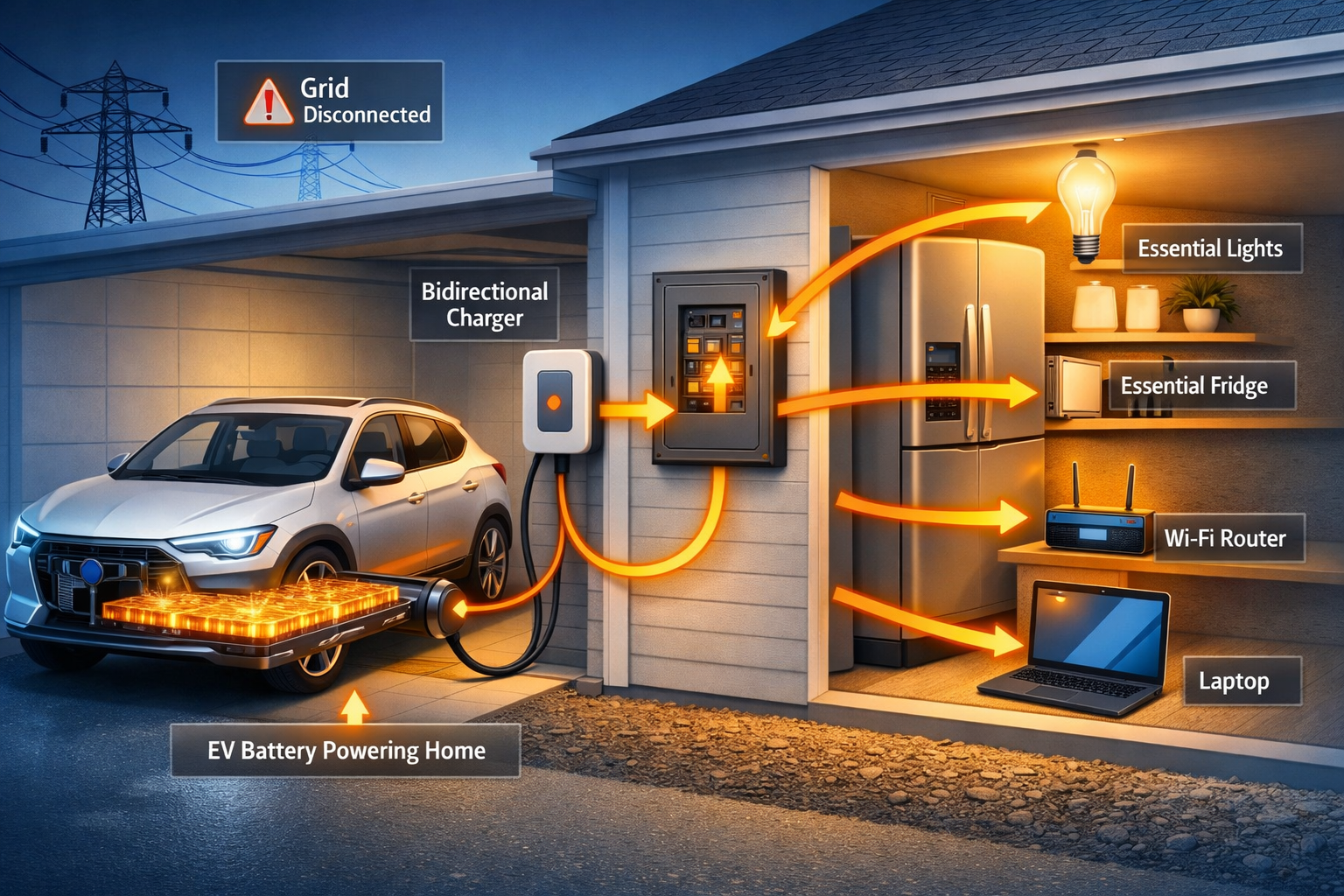
Depending on the equipment, that transition may be automatic or require a homeowner to take a few manual steps. Once backup mode is active, the system draws direct-current energy from the vehicle battery, converts it as needed, and feeds stable power to a dedicated backup panel or selected circuits in the main panel.
What typically stays on
Most homeowners get the best results by prioritizing modest, essential loads rather than trying to operate the entire house. A carefully designed critical-loads panel may include:
- Refrigerator and freezer circuits
- LED lighting in key rooms
- Internet modem, router, and phone charging
- Selected kitchen outlets for small appliances
- Garage door opener and security equipment
- Sump pump or well pump, if the system output supports it
- Medical equipment that has been evaluated with the installer and equipment provider
Duration is a calculation of usable battery capacity and household demand. An EV with a large battery may store several times the energy of a typical stationary home battery, but the available runtime still changes dramatically with usage. Keeping lights, refrigeration, internet, and electronics running may use a manageable amount of energy. Running electric resistance heat, an oven, or central air conditioning can consume energy much faster.
Think in terms of energy, not just battery size. A larger EV battery can provide longer backup, but conservation and smart circuit selection are what turn stored energy into useful hours—or even days—of resilience.
A practical runtime example
Suppose a household reserves 50 kilowatt-hours of usable energy in an EV for an outage. If essential loads average 1 kilowatt over time, that reserve could theoretically support those loads for roughly 50 hours. Real-world results vary because appliances cycle on and off, conversion losses occur, temperatures affect equipment, and a pump or kitchen appliance can cause temporary spikes. Still, this example shows why reducing demand matters as much as increasing battery capacity.
The Equipment Needed for a Vehicle-to-Home System
A safe V2H installation is a system, not a single plug. Products and approaches differ by vehicle manufacturer and region, but most installations involve several coordinated components.
- A V2H-compatible electric vehicle. The vehicle must explicitly support approved bidirectional home backup in the market where it will be used. A large battery alone does not guarantee this capability.
- Compatible charging or power-conversion hardware. Some systems use a dedicated bidirectional charger, while others use manufacturer-specific integrated power equipment. Connector standards, software, and approved accessory requirements all matter.
- Transfer switch or energy-management equipment. This component isolates the home from the utility and routes power to selected circuits. It is essential for electrical safety and utility compliance.
- A critical-loads panel or properly configured main panel. The installer may move priority circuits into a separate panel or use load-management controls to prevent the system from being overloaded.
- Professional design, permitting, and inspection. Local code, utility interconnection rules, service-panel capacity, grounding, and manufacturer instructions determine what is allowed at a specific property.
Compatibility deserves special attention. The EV, connector, firmware, charger, transfer equipment, and home electrical service must work together as an approved combination. Before buying equipment, verify the exact vehicle trim and model year, regional availability, maximum output rating, warranty implications, and installation requirements with qualified professionals.
Safety note: Never attempt to energize home wiring through an improvised connection. A listed, properly installed transfer method is necessary to protect people, equipment, and utility crews.
Why EV Backup Power Is Valuable for Homeowners
The central appeal of V2H is resilience. Instead of relying exclusively on a portable fuel generator, homeowners may be able to use energy already stored in a vehicle parked at home. During a storm, wildfire-related shutoff, equipment failure, or other outage, that stored electricity can keep the household functional while waiting for grid service to return.

Less dependence on combustion-based backup
Portable generators remain useful tools, especially where outages are frequent or long. But they require fuel storage, outdoor placement, ventilation, maintenance, and careful refueling. An EV-based system can provide quiet, emissions-free power at the home during operation, without the noise and local exhaust associated with gasoline or diesel equipment.
Making better use of an existing battery
For a household that already owns a compatible EV, V2H can potentially reduce the need to purchase a separate stationary battery strictly for basic backup. That does not mean the options are interchangeable: a stationary battery remains at home even when the car is away, and it may integrate differently with solar. But an EV’s battery capacity can be a significant asset that otherwise sits unused for much of the day.
A foundation for smarter energy management
V2H can also complement solar generation, time-of-use electricity plans, and intelligent load controls. In a well-designed system, homeowners may be able to manage when they charge the vehicle, preserve a chosen backup reserve, and prioritize critical circuits. The most advanced uses depend on local rules and equipment capabilities, but the broader idea is clear: the EV can become part of a household energy strategy rather than functioning only as transportation.
Why this matters
An EV battery can be particularly valuable when it is paired with a clear outage plan. Prioritized circuits, a battery reserve, and sensible energy habits deliver more practical security than simply connecting the largest battery available.
Important Limitations to Consider Before Installing V2H
V2H is promising, but it is not universally available or appropriate for every household. The first limitation is compatibility. Not every EV supports bidirectional export, and support can vary by model year, location, connector type, software version, and manufacturer-approved equipment. A feature advertised in one market may not be enabled or approved in another.
Output power is another constraint. Battery capacity describes how much energy is stored; output rating describes how much power the system can provide at once. A backup system may have enough stored energy to run critical loads for an extended period while still being unable to start or sustain multiple high-demand appliances at the same time.
Be especially cautious with loads such as:
- Central air conditioning and heat pumps during high demand
- Electric furnaces and resistance space heating
- Electric ovens, ranges, dryers, and water heaters
- Large pool equipment and workshop tools
- Pumps with high startup or locked-rotor current
There are also practical trade-offs. If the vehicle is used heavily for driving, homeowners must decide how much charge to reserve for transportation and how much to make available to the house. Frequent energy cycling may be relevant to long-term battery health and warranty terms, so it is worth reviewing manufacturer documentation rather than assuming all use cases are treated identically.
Finally, budget for more than the charger. Electrical upgrades, a transfer switch, load controls, labor, permits, inspection, and possible panel work can shape the total cost. Local utility and electrical requirements may also influence equipment choices and installation timelines.
How to Decide Whether Vehicle-to-Home Charging Is Right for You
The best starting point is not the vehicle—it is the home’s outage needs. Define what “backup power” means for your household. Is the goal to keep food cold overnight? Maintain internet for remote work? Operate a sump pump during severe weather? Support critical health-related equipment? Each answer leads to a different system design.
Build an essential-loads list
List each circuit or appliance you want available in an outage, its approximate running wattage, how long it would operate per day, and whether it has a high startup demand. An electrician or energy professional can help turn that list into a realistic critical-loads plan. This process often reveals easy opportunities to reduce demand, such as using LED lights, limiting appliance use, or separating nonessential circuits.
Verify the full compatibility path
Confirm that your specific EV supports V2H—not just bidirectional charging in theory—and identify the approved hardware. Then have a qualified installer assess your electrical service, panel layout, parking location, cable routing, grounding, local permits, and utility rules. This assessment should happen before equipment is ordered.
Compare realistic alternatives
V2H is one of several paths to backup power. Compare it with portable generators, permanently installed generators, stationary home batteries, and solar-plus-storage systems. Consider outage frequency, typical duration, fuel availability, noise tolerance, budget, whether your car is usually home during emergencies, and long-term energy goals.
- Identify the circuits that matter most during an outage.
- Estimate both their energy use and peak power demand.
- Check the precise V2H capability of your EV or planned EV.
- Request a site assessment from a qualified, manufacturer-approved installer where applicable.
- Choose a system that meets local code while preserving an appropriate driving reserve.
Plan for Smarter, More Resilient Home Energy
Vehicle-to-home charging gives electric vehicles a compelling second role: a flexible source of stored electricity when the grid goes down. A compatible EV, bidirectional charger, transfer equipment, and thoughtful circuit design can keep essential parts of a home operating without treating the vehicle as an unlimited power source.
The strongest V2H plans begin with practical expectations. Prioritize essential loads, understand your battery reserve, confirm every layer of compatibility, and use licensed professionals for system design and installation. With those foundations in place, an EV can provide more than transportation—it can become a meaningful part of a resilient home energy system.
Take the Next Step
Review your essential circuits and speak with a qualified installer about EV compatibility, bidirectional charging equipment, and local requirements. A well-planned V2H system can help keep the home systems you rely on powered when the grid is unavailable.