






Battery-Free Smart Textiles: How Movement Powers Wearables

Wearable technology · Energy harvesting
Battery-Free Smart Textiles: How Movement Powers Wearables
Could your next wearable be powered by what you wear? Experimental smart textiles can harvest energy from everyday movement—but powering a tiny sensor is very different from charging a phone.
A sleeve bends. A shoe presses against the ground. Two layers of fabric brush together as you walk. Each action moves mechanical energy through your clothing. With the right materials and electrical design, a small portion of that energy can become electricity.
That is the promise of battery-free smart textiles: clothing that does more than carry electronics, using its own deformation or contact with other surfaces to support useful functions. The most credible near-term opportunity is not a wardrobe that charges every device. It is unobtrusive sensing that needs fewer battery changes—or, for a carefully defined task, no battery at all.
Understanding the difference requires looking beyond the fabric itself. Harvesting energy, measuring movement, processing information, and transmitting a result are separate jobs. A convincing wearable has to make them work together.
What Battery-Free Smart Textiles Actually Mean
Smart textiles are fabrics that incorporate functions such as sensing, electrical conduction, energy harvesting, or interaction with electronic components. A shirt with conductive tracks is a smart textile, but those tracks do not necessarily generate electricity. A fabric sensor can also require an external power supply.
In a genuinely battery-free design, the specified function operates without a battery. Energy may come from movement, light, body heat, or an external wireless field. A battery-assisted design instead uses harvested energy to reduce battery drain or extend the interval between charges. Both approaches can be useful, but they are not interchangeable claims.
Battery-free also does not mean storage-free. A capacitor or supercapacitor can accumulate small amounts of energy and release them when a circuit needs a short burst of power. This buffer helps bridge the mismatch between irregular movement and electronics that require a stable supply.
Ask whether “battery-free” describes the fabric sensor alone or the complete operating system. A self-generating sensing element connected to externally powered measurement equipment is not yet an independently powered wearable.
This distinction also applies to the broader category of battery-free gadgets powered by ambient energy: the energy source matters, but so does the exact job it can sustain.
Editorial note: Techmark’s website could not be accessed for verification. This article does not claim to reflect its newest coverage or to have been checked against its archives. The internal reading links supplied with this article have not been independently reviewed.
How Fabric Converts Everyday Movement into Electricity
Two frequently explored approaches are triboelectric and piezoelectric harvesting. Both convert mechanical input into electrical output, but their underlying mechanisms differ.
Triboelectric textiles: contact, separation, and charge
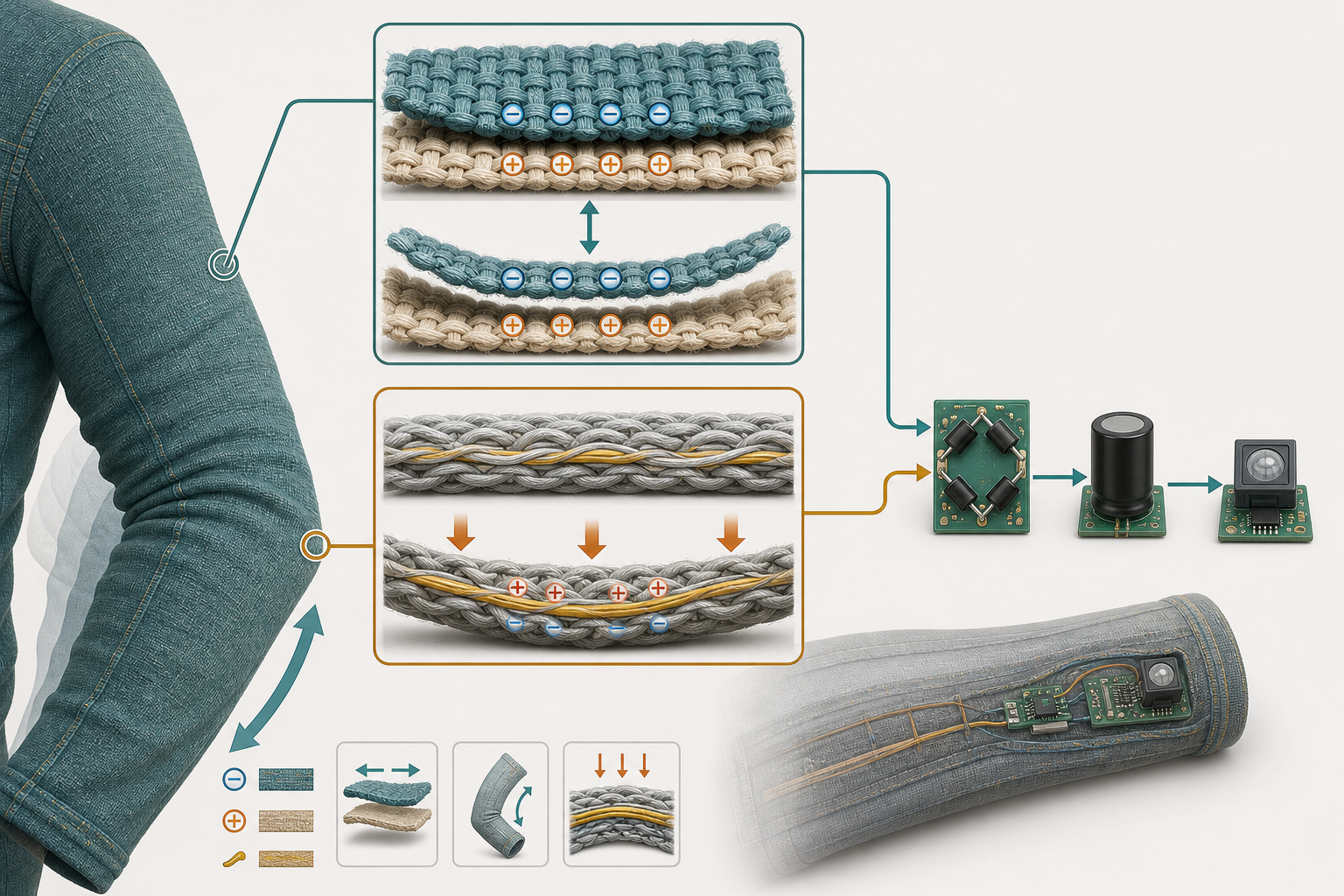
A triboelectric generator combines contact electrification with electrostatic induction. When selected materials touch, electrical charge can redistribute between their surfaces. When those surfaces separate or slide, their changing arrangement creates a potential difference that can drive current through an external circuit.
In triboelectric nanogenerator smart clothing, movement might repeatedly bring two textile layers together and pull them apart. Electrodes collect the resulting electrical output. Material choice, surface texture, spacing, and the way the garment moves all affect performance.
The word “nanogenerator” does not mean the entire garment or generator is nanoscale. In this field, it names a class of energy-harvesting devices, some of which use engineered micro- or nanoscale surface features.
Piezoelectric textiles: electricity from deformation
Piezoelectric materials generate electrical charge when mechanical stress changes their polarization. Suitable materials can be incorporated into fibers, coatings, or flexible structures so that bending, stretching, or compression produces an electrical response.
Integration matters as much as material selection. A fiber must experience useful strain without making the garment stiff, fragile, or uncomfortable. An impressive response from an isolated sample does not automatically translate into effective harvesting when that sample is sewn into loose clothing.
The rest of the electrical pathway
Conductive yarns usually transport signals or current; conductivity alone does not make them harvesters. They are more like wiring than a power source. A practical energy-harvesting textile also needs electronics that turn the generator’s variable output into something a device can use.
Movement → harvesting element → rectification and power management → optional energy storage → sensor, processor, or transmitter
Rectification converts alternating or pulsed output into a usable direction of current. Power-management circuits handle voltage conversion and decide when enough energy is available to operate the load. Those circuits consume energy too, so efficient operation at very low input levels is essential.
Other harvesting methods can complement movement. Thermoelectric generators use a temperature difference, while solar textiles use light. Neither runs on motion, and each introduces different constraints: thermal contact and heat flow for one, illumination and exposed area for the other.
How Much Wearable Power Can Movement Really Provide?
There is no single useful output figure for “smart fabric.” Harvested energy varies with movement frequency, force, active area, material selection, humidity, and electrical loading. Placement matters too: a panel over a frequently bending joint experiences different input from fabric hanging loosely across the torso.
Humidity and sweat can change surface charge behavior and leakage in triboelectric systems. Mechanical coupling affects how strongly a piezoelectric element deforms. The same prototype may therefore behave differently on different wearers, during different activities, or under different environmental conditions.
The most important distinction is between peak output and average usable energy. A high open-circuit voltage tells you the potential difference when little or no current is being drawn. It does not establish how much energy reaches storage or how reliably a device can operate.
The useful question is not “How high is the voltage?” It is “What function runs, how often, and under what conditions?”
A realistic design may collect energy while the wearer walks, charge a capacitor, then briefly wake a circuit to take a measurement or transmit a packet. This is duty-cycled operation: spending much of the time asleep so that occasional useful work fits within the energy budget.
The budget must include conversion losses, storage leakage, startup, computation, and communications—not just the sensor. Wireless transmission can demand a brief burst that the harvester cannot supply directly, making storage and scheduling especially important.
Many research demonstrations consequently target low-power sensing or intermittent functions. Continuous smartwatch operation, bright displays, and meaningful smartphone charging are very different workloads. A fabric that lights an indicator under repeated tapping has demonstrated energy conversion, not universal charging capability.
When numerical performance claims appear, look for the original study and its test conditions: active area, motion input, load, averaging interval, and whether the result came from controlled laboratory actuation or actual wear. Without those details, comparisons can be misleading.
Where Movement-Powered Clothing Could Be Useful
The following are research directions and prototype concepts, not a claim that independently powered garments are widely available or clinically validated.
Gait and rehabilitation research
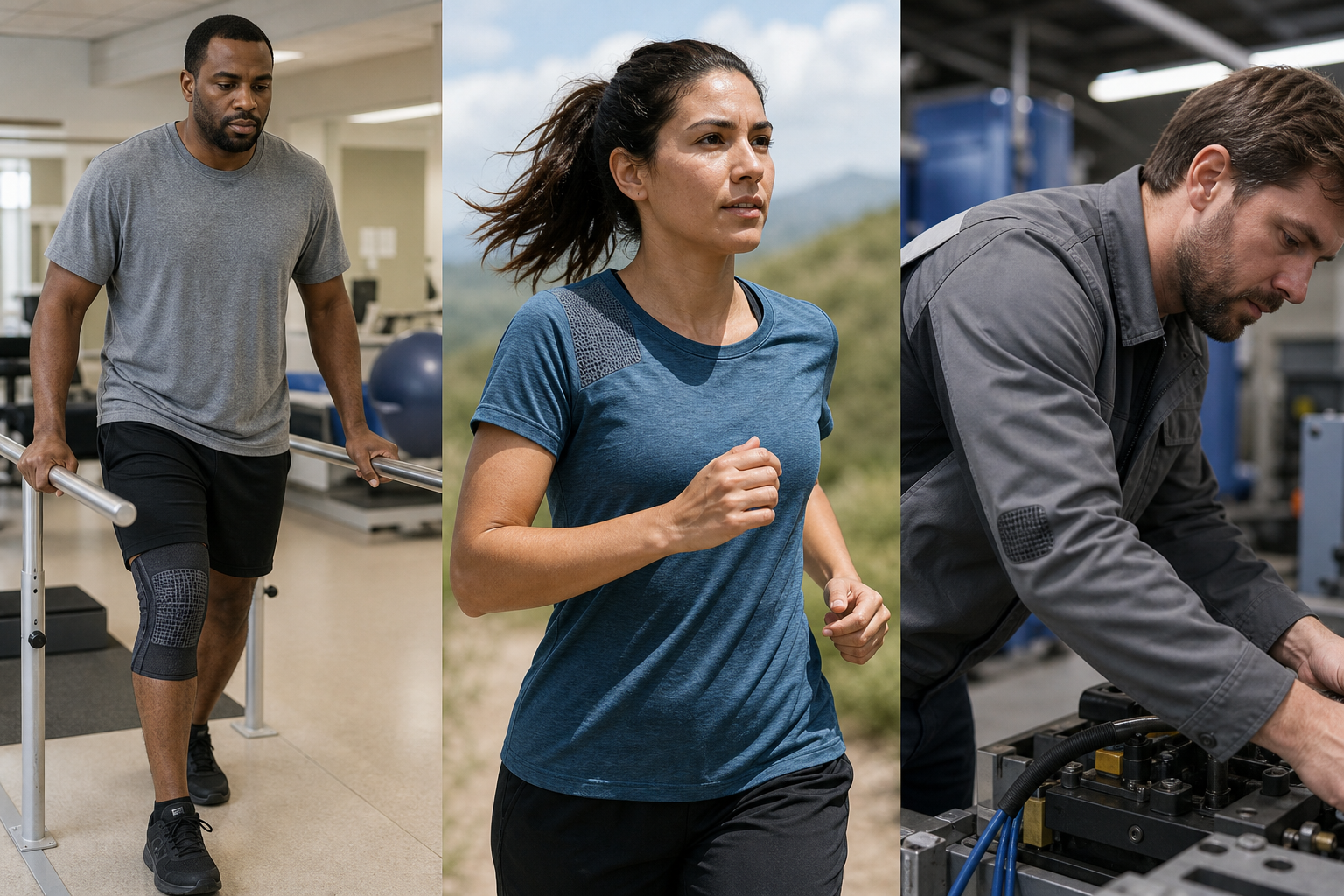
Footsteps and joint movement can provide both a source of mechanical energy and a signal to measure. A textile panel near the knee, for example, could produce an electrical response associated with bending. Researchers can investigate whether that response helps characterize movement patterns.
However, sensing motion is not the same as assessing recovery. Garment fit, placement, walking speed, and individual differences can change the signal. Rehabilitation applications require validation against suitable reference measurements and, where relevant, clinical evaluation.
Sportswear and training feedback
Movement-powered wearable sensors could support intermittent measurements of cadence, repeated bending, or other activity-related patterns. Integration into clothing might reduce the need for separate rigid attachments.
Accuracy and comfort remain decisive. A sensor that shifts during a run or responds differently after getting sweaty may produce inconsistent results. Compared with familiar devices discussed in the evolution of smart rings beyond fitness, textile systems must also contend with clothing size, drape, and changing contact with the body.
Workwear and occupational monitoring
Flexible sensing panels in workwear could potentially record repetitive movements or activity patterns. But movement harvesting cannot, by itself, guarantee dependable safety monitoring. A worker who becomes motionless may also stop generating the energy a motion-powered system needs.
Safety-critical functions therefore require explicit reliability analysis, appropriate backup arrangements, and a clear response to missing data. “No message received” must not silently become “everything is fine.”
Across these applications, distinguish a self-generating sensing signal from a complete self-powered system. A textile may produce a pulse that reveals movement while a separate powered instrument records it. Processing, storage, and wireless reporting must be demonstrated separately before claiming autonomous operation.
The Obstacles Between a Lab Prototype and Your Laundry Basket
Durability includes the connections
Clothing gets washed, twisted, stretched, rubbed against furniture, and exposed to sweat. These stresses can damage coatings, alter surface properties, and weaken conductive pathways. Connections between soft fabric and relatively rigid electronic modules are particularly vulnerable.
A useful washability claim needs context: detergent, temperature, cycle type, drying method, and which components were removed. Electrical performance should be measured after washing, not inferred from whether the garment still looks intact.
Power cannot come at the expense of wearability
Extra layers, surface treatments, and encapsulation may improve electrical performance or protect components. They can also reduce breathability, increase weight, or change how fabric feels against skin. Skin compatibility deserves attention, especially when sweat increases exposure to materials and finishes.
There is also a basic energy trade-off. Movement-derived electricity comes from mechanical work; it is not free energy. A design should extract useful energy without creating noticeable drag, stiffness, or discomfort.
Stillness, manufacturing, and maintenance
During inactivity, a movement-only harvester may supply little or no energy. Stored energy can bridge a limited gap, but not an indefinite one. Designs must either tolerate downtime, reduce their workload, or use another source.
Scaling production brings further challenges: consistent fiber properties, reliable connections, repeatable coatings, and quality checks across large areas of fabric. Repairability matters too. A detachable electronics module may make cleaning and replacement easier, even if it is less visually seamless.
Finally, battery-free is not automatically environmentally harmless. Material sourcing, specialized coatings, electronics, manufacturing impacts, service life, and end-of-life separation all matter. Eliminating a battery is beneficial only within the broader picture of what is added, how long it lasts, and whether it can be repaired or recovered.
What to Look for in the Next Generation of Smart Fabrics
When evaluating an announcement about self-powered electronic textiles, use a system-level checklist rather than judging the headline number.
- Identify the demonstrated function. Did the fabric generate a signal, charge storage, run a sensor, or transmit data? Those are different milestones.
- Check the power boundary. Find out which components relied on external equipment, batteries, or wireless power.
- Look for realistic movement tests. Ordinary wear should complement controlled laboratory results, with transparent reporting of average output and operating intervals.
- Examine the complete energy budget. Storage, power management, startup, processing, and transmission all need to be accounted for.
- Ask about repeated use. Wash protocols, abrasion testing, performance retention, comfort evaluations, and clear care instructions matter.
- Check what happens when movement stops. Dependable systems should explain interruptions rather than hide them behind an average output figure.
Hybrid harvesting could broaden the operating window: light may contribute while someone sits still, for example. Better low-power electronics can also make a smaller energy supply more useful. But additional harvesters, circuits, and connections increase complexity, cost, and potential failure points.
The strongest progress may therefore look modest: fewer maintenance interruptions, a thinner sensing module, or a garment that reports a useful event without needing frequent charging. That fits the broader idea of ambient computing that works quietly in the background, provided the underlying technology earns that invisibility through reliability.
Look Beyond the Headline: Ask What the Fabric Actually Powers
Battery-free smart textiles offer a credible route toward low-maintenance sensing, not unlimited wearable electricity. Triboelectric and piezoelectric structures can turn movement into electrical output, but useful operation depends on the entire chain: materials, power management, storage, electronics, and real-world wear.
The breakthrough worth watching is a complete system that performs a clearly defined task, survives ordinary care, and remains comfortable. A small sensor that reliably needs less maintenance may matter more than a dramatic voltage reading.
When the next self-powered clothing announcement appears, ask three questions: What does it power? Under what conditions? Does it still work after everyday wear and washing? Those answers reveal more than the headline.