

How Bluetooth LE Audio Makes Wireless Listening More Flexible and Accessible
How Bluetooth LE Audio Is Making Wireless Listening More Flexible and Accessible
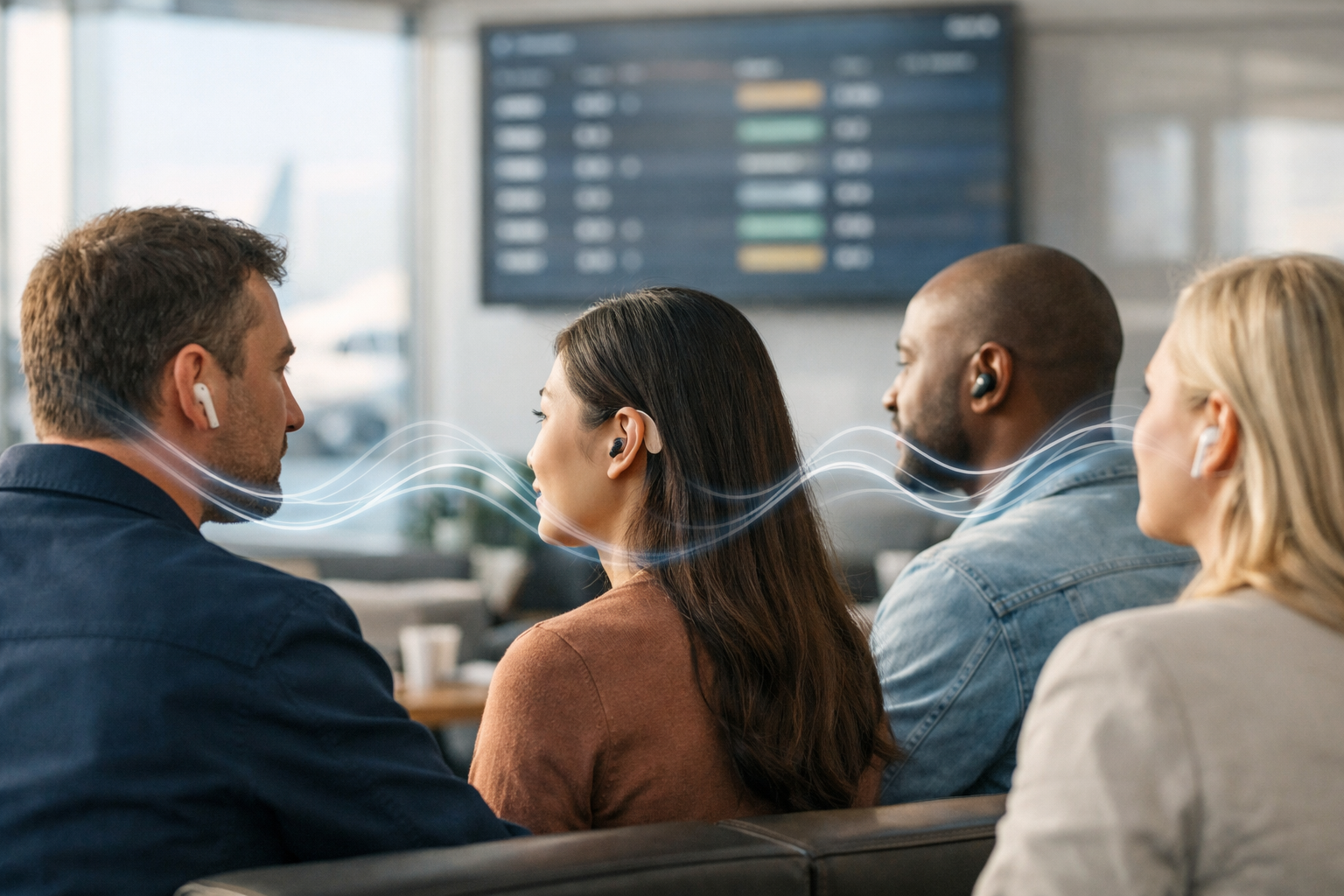
Wireless audio has traditionally been a one-to-one experience: one phone sends sound to one pair of headphones. Bluetooth LE Audio expands that model. It is designed to make listening more power-efficient, more adaptable across devices, and more inclusive in settings where people need clearer access to shared sound. From compact earbuds to hearing devices and public broadcasts, the technology points toward a more personal way to hear the world around us.
What Is Bluetooth LE Audio?
Bluetooth LE Audio is a newer audio architecture built on Bluetooth Low Energy, the Bluetooth radio mode developed for lower-power communication. It is not simply an updated label for ordinary Bluetooth headphones. Instead, it establishes a different technical foundation for sending audio, connecting devices, and delivering sound to more than one listener.
Classic Bluetooth audio remains widely used and will continue to matter for years because of its enormous installed base. LE Audio, however, is intended to address several limitations of older approaches: battery constraints in very small devices, rigid left-and-right earbud connections, limited options for public audio sharing, and inconsistent support between consumer electronics and hearing technology.
The role of the LC3 codec
At the center of LE Audio is the Low Complexity Communications Codec, or LC3. A codec is the system that compresses audio for transmission and reconstructs it at the receiving end. LC3 is designed to provide strong perceived audio quality at lower bitrates than older Bluetooth audio approaches, which can reduce the amount of data and power needed to send a listening stream.
That does not mean every LE Audio product will automatically sound better than every older Bluetooth product. Audio quality still depends on the source recording, tuning, speaker or receiver hardware, microphone quality, radio conditions, and the manufacturer’s implementation. The practical promise is efficiency: designers have more room to balance sound quality, battery life, latency, calls, and small-device ergonomics.
Bluetooth LE Audio is a platform rather than a single feature. LC3, broadcast audio, and multi-stream capabilities can work together, but a product must explicitly support the features you want.
Compatibility is especially important. A phone may support LE Audio while a current pair of earbuds does not; an earbud may support the basic standard but not receive public broadcasts; a venue may transmit Auracast audio that an older device cannot access. In most cases, both the source and the listening device need appropriate hardware and software support.
LE Audio versus classic Bluetooth
| Capability | Classic Bluetooth audio | Bluetooth LE Audio |
|---|---|---|
| Primary design approach | Established point-to-point wireless audio, commonly used by today’s headphones and speakers. | Low-energy audio architecture designed for efficient unicast, multi-stream, and broadcast listening. |
| Core codec | Often relies on SBC, with optional brand- and device-specific codecs in many products. | Introduces LC3 as the required baseline codec for LE Audio. |
| Shared public listening | Usually requires proprietary systems, dedicated receivers, or separate infrastructure. | Can support one-to-many broadcasts through Auracast broadcast audio. |
| Hearing accessibility potential | Compatibility can vary substantially by device and ecosystem. | Creates a more standardized foundation for compatible hearing devices and public broadcasts. |
Better Efficiency Can Mean More Listening Flexibility
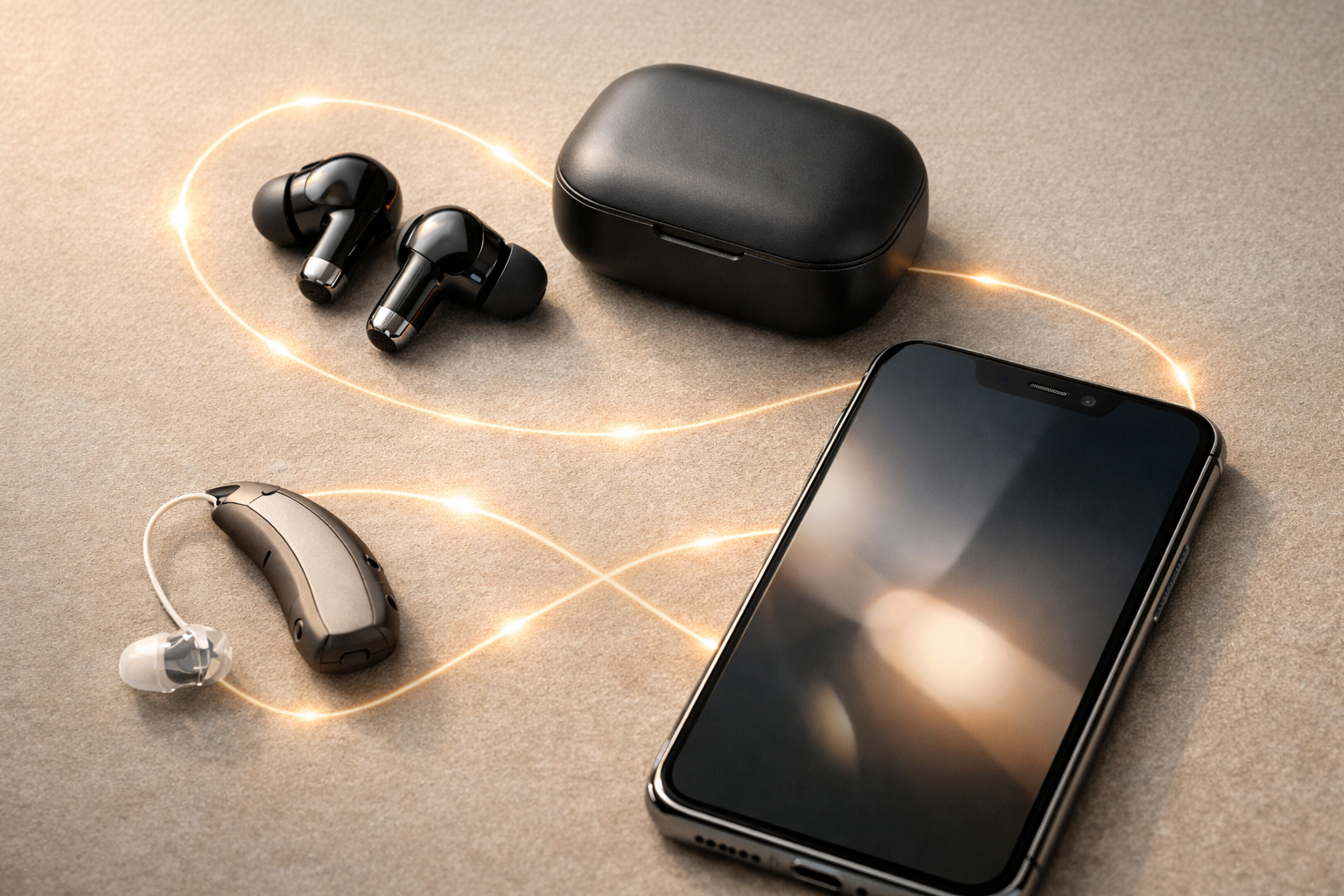
Battery life is one of the most visible constraints in wireless listening. Tiny earbuds must power radios, audio processing, microphones, touch controls, and sometimes active noise control in a very small enclosure. Hearing devices face similar constraints while also prioritizing all-day comfort and reliable amplification. Efficiency does not eliminate those engineering trade-offs, but LE Audio gives manufacturers a more useful set of options.
Because LC3 is designed to deliver audio efficiently, a manufacturer may choose to use that efficiency in different ways. One product may target longer playback time. Another may maintain a compact physical design. A third may devote more of its power budget to better microphones, environmental processing, or connection stability. The outcome is not one universal battery-life figure; it is greater flexibility in product design.
Why lower-power audio matters in everyday use
- Smaller wearables: Designers can pursue lighter earbuds and discreet hearing devices without treating every extra feature as an immediate battery penalty.
- More balanced feature sets: Products can better distribute available power across playback, call microphones, noise management, and wireless reliability.
- Potentially longer useful listening: Efficient audio transport can contribute to longer runtime, particularly when the full device design is optimized around it.
- Broader device categories: Lower-energy operation is valuable for compact assistive products, transmitters, and future wearable designs.
There are important limits to keep in mind. A codec alone cannot overcome poor antenna design, a congested radio environment, aging batteries, or a weak audio source. Likewise, manufacturers may make different choices about bitrate, processing features, and connection modes. Real-world performance remains product-specific, so independent testing and published battery estimates are still worth reviewing before buying.
Efficiency is most valuable when it creates choice. Bluetooth LE Audio gives product makers more room to decide whether a listener benefits most from a smaller device, longer runtime, richer features, or a thoughtful combination of all three.
Auracast Brings Shared Audio to More Places
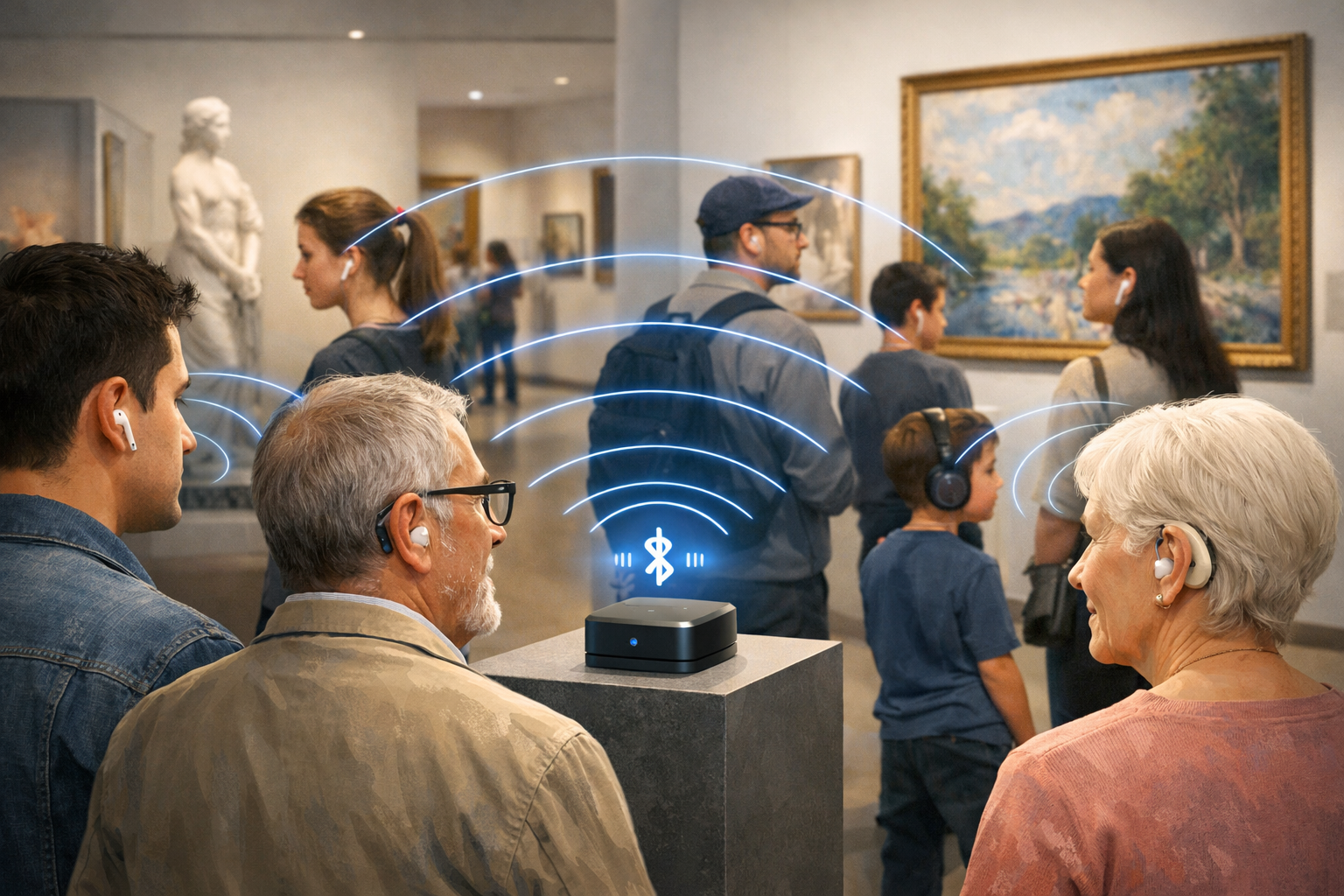
One of the most transformative LE Audio capabilities is Auracast broadcast audio. Rather than pairing one transmitter with one set of headphones, an Auracast-enabled transmitter can send an audio broadcast that many compatible receivers can join. Think of it less like handing out individual wireless receivers and more like making an audio channel available in a specific place.
A listener could use a compatible phone, earbuds, headset, or hearing device to select an available broadcast. Depending on the setup, a venue may share a broadcast name, a QR code, a screen prompt, or an audio assistant workflow to help people find it. Some broadcasts may be open; others can be configured with access controls for private events or secure environments.
Where broadcast audio can make a difference
Auracast is useful wherever people are trying to hear the same thing but have different listening needs, distances, languages, or levels of background noise. Potential applications include:
- Airports and transit hubs: gate changes, boarding announcements, and service alerts can be delivered directly to a listener’s personal device.
- Gyms, cafés, and waiting rooms: people can tune into muted televisions without turning a room into a wall of competing sound.
- Museums and visitor attractions: audio tours can be offered through visitors’ own compatible equipment alongside traditional lending options.
- Classrooms and conferences: presenters can provide clearer audio to a room of attendees, including people seated farther away.
- Sports and live events: commentary, translations, or supplementary programming can become a personal optional layer.
Public broadcast audio also changes the social dynamic of listening. Instead of requiring everyone to use venue-issued hardware or gather around a single speaker, individuals can choose how they participate. A person might listen through earbuds at a comfortable volume, use compatible hearing technology, or decline the audio entirely without changing the experience for others.
A compatible broadcaster sends one audio stream, and many compatible listeners can join it. It is a one-to-many model that can make shared sound feel personal, portable, and less dependent on dedicated receivers.
A Meaningful Step Forward for Hearing Accessibility
For many people with hearing loss, the hardest listening situations are not quiet conversations at home. They are noisy, reverberant, fast-moving public places: an airport gate, a lecture hall, a group tour, or a television playing across a waiting room. Sound loses clarity with distance and competing noise. Delivering audio closer to the listener’s ears can reduce some of those barriers.
Bluetooth LE Audio supports features intended to improve interoperability between compatible hearing aids and consumer devices. Its importance is not that it guarantees a perfect experience for every person, but that it provides a more standardized technical path for manufacturers, phone makers, venue operators, and assistive-technology providers to build compatible solutions.
Direct access to public audio
When a venue offers Auracast and a visitor uses a compatible hearing device, the visitor may be able to tune directly into the broadcast rather than rely only on a room speaker. This can be particularly valuable for speech-based information such as announcements, guided commentary, presentations, and TV dialogue.
Direct delivery does not replace professional hearing care, venue accessibility planning, captions, visual alerts, induction loops, or human assistance. It should complement them. People use different devices, have different communication preferences, and may not own compatible technology. The most inclusive environments provide multiple paths to the same essential information.
What accessible implementation looks like
- Make broadcasts easy to discover. Clear signs, screens, and staff instructions should explain that audio is available and how to join.
- Use understandable names. Labels such as “Gate B12 Announcements” or “Gallery 3 Audio Guide” are more helpful than generic technical names.
- Keep non-audio alternatives available. Captions, visual displays, printed information, and trained staff remain essential.
- Offer a practical fallback. Loaner receivers or headphones can help visitors who do not yet have compatible devices.
- Test the full experience. A broadcast that technically works but is hard to find, poorly labeled, or inconsistently staffed is not truly accessible.
Accessibility is not achieved by adding one signal type. It is achieved when people can reliably discover, understand, and choose the format that works best for them.
More Natural Stereo and Multi-Device Experiences
Bluetooth LE Audio can support Multi-Stream Audio, which allows independent audio streams to be sent to each earbud or hearing device. In older wireless earbud arrangements, one bud could act as the primary receiver and relay information to the other. Multi-stream designs can give manufacturers more flexibility in how left and right channels are handled and synchronized.
For listeners, this may contribute to more reliable stereo imaging, smoother device behavior, and a better foundation for personalized listening. Independent streams can also be meaningful for hearing devices, where the two sides may need different settings based on a person’s hearing profile or listening environment.
It is important, though, not to turn a technical capability into a blanket promise. Features such as seamless phone-to-laptop switching, advanced multipoint connections, spatial audio, low-latency gaming modes, or upgraded call performance are implemented differently across brands. Some may use LE Audio, some may combine it with other technologies, and some may not be offered at all.
“Bluetooth LE Audio” tells you that a product supports a newer platform. It does not automatically confirm Auracast receiving, broadcast transmitting, multipoint behavior, hearing aid compatibility, or a specific battery-life result.
What to Look for Before You Upgrade
LE Audio is still rolling out across phones, computers, earbuds, hearing devices, televisions, and venue infrastructure. That makes this a transition period: the potential is substantial, but compatibility research matters. Before replacing a device specifically for LE Audio, look beyond broad marketing language and verify the exact functions supported.
A practical compatibility checklist
- Confirm both ends of the connection. Your phone, tablet, computer, TV, or transmitter and your earbuds, headphones, or hearing devices should explicitly list LE Audio support.
- Check the Auracast role. A device may be able to receive broadcasts, transmit broadcasts, or do both. These are different capabilities.
- Review software requirements. Some support may arrive through operating-system or firmware updates, while other capabilities require newer hardware.
- Read hearing-device compatibility details. If accessibility is the priority, confirm support with the hearing-device manufacturer and discuss fit with a hearing care professional when appropriate.
- Ask where you will use it. Auracast is most compelling if compatible broadcasts are available at your workplace, school, travel hubs, venues, or frequently visited public spaces.
- Evaluate the everyday basics. Comfort, microphone quality, controls, repairability, battery performance, and sound tuning remain just as important as the wireless standard.
It can also help to separate immediate needs from future readiness. If your existing headphones work well and your day-to-day routine does not involve broadcast-enabled spaces, there may be no urgent reason to upgrade. But if you are choosing new earbuds, fitting compatible hearing technology, or planning audio infrastructure for a public venue, LE Audio support can be a sensible long-term consideration.
Questions venues and organizations should ask
For organizations, the opportunity is larger than installing a transmitter. Teams should ask which information is most important to make accessible, whether broadcasts need multiple languages or channels, how guests will discover the service, and what alternatives are available for people without compatible equipment. Privacy, emergency communication procedures, and staff training should be part of the design from the beginning.
A well-run system can make an announcement, presentation, or program easier to hear without forcing every visitor into the same listening arrangement. That flexibility is the real value: it supports personal control while preserving a shared experience.
Explore the Next Generation of Wireless Listening
Bluetooth LE Audio brings together efficient sound delivery, flexible multi-device design, Auracast shared broadcasts, and a stronger foundation for hearing accessibility. Its impact will grow as compatible devices and public transmitters become more common.